How to Read a Horoscope - Explained From Absolute Zero
No prior knowledge assumed. If you've ever nodded along when someone mentioned their "7th house" without having any idea what that meant, this is for you.
What a Horoscope Actually Is
Strip away every mystical association the word carries, and a horoscope (in Sanskrit, a janma kuṇḍalī, or birth chart) is simply a map. Specifically, it's a map of where the Sun, Moon, and five visible planets were positioned in the sky, against the backdrop of the twelve zodiac constellations, at the exact moment and place you were born.
That's it. No more mysterious than a photograph of the night sky taken at your first breath, with the positions carefully noted down. What follows — the interpretation of what those positions mean — is where the actual craft of Jyotiṣa lives. But the chart itself, before anyone reads a single meaning into it, is just an accurate snapshot of astronomy.
Every horoscope, no matter how it's drawn or which tradition produced it, is built from combining exactly three ingredients:
Rāśis (the 12 zodiac signs) + Bhāvas (the 12 houses) + Grahas (the 9 "planets")
Understand these three things, and you can already read the basic skeleton of any horoscope placed in front of you. Let's take them one at a time.
Part 1 — Rāśis: The Twelve Zodiac Signs
The sky, as seen from Earth, is divided into a band called the ecliptic — the path the Sun appears to travel along over the course of a year. Jyotiṣa divides this band into twelve equal 30° slices. Each slice is a rāśi, commonly translated as "sign." These are the same twelve names you've likely already heard — Aries, Taurus, Gemini, and so on — because Vedic and Western astrology both inherited the same underlying twelve-fold division, even though (as we've written about elsewhere on this site) they measure it against slightly different reference points.
Every rāśi has a general character or flavor associated with it — not a fixed personality that defines anyone born under it, but a kind of symbolic texture that colors whatever planet or house happens to sit within it.
| Rāśi | Symbol | General Character |
| Aries (Meṣa) | Ram | Initiating, energetic, direct, impatient for action |
| Taurus (Vṛṣabha) | Bull | Steady, sensual, patient, deeply resistant to change |
| Gemini (Mithuna) | Twins | Curious, communicative, restless, quick-thinking |
| Cancer (Karkaṭa) | Crab | Nurturing, emotional, protective, home-oriented |
| Leo (Siṃha) | Lion | Confident, expressive, proud, natural leader |
| Virgo (Kanyā) | Maiden | Precise, analytical, service-minded, self-critical |
| Libra (Tulā) | Scales | Harmony-seeking, diplomatic, relationship-focused |
| Scorpio (Vṛścika) | Scorpion | Intense, private, transformative, deeply loyal |
| Sagittarius (Dhanu) | Archer | Philosophical, adventurous, freedom-loving, blunt |
| Capricorn (Makara) | Sea-Goat | Disciplined, ambitious, patient, duty-bound |
| Aquarius (Kumbha) | Water-Bearer | Independent, unconventional, idea-driven, detached |
| Pisces (Mīna) | Fish | Imaginative, compassionate, spiritual, boundary-blurring |
Part 2 — Bhāvas: The Twelve Houses
If rāśis are the backdrop, bhāvas (houses) are the actual stage sets — the twelve life-departments a chart is divided into. Every chart has exactly twelve houses, always, regardless of whose chart it is. What differs from person to person is which rāśi and which planets happen to occupy each house.
The 1st house always begins at the Lagna, or Ascendant — the exact point of the zodiac that was rising over the eastern horizon at the precise moment of birth. This is why the exact time of birth matters so much in Jyotiṣa: a few minutes' difference can shift the Lagna into a different sign entirely, which reshuffles which rāśi governs every single one of the twelve houses that follow it.
From the Lagna, the remaining eleven houses are simply counted onward in order around the chart. Here's what each one governs:
| House | Sanskrit | Governs |
| 1st | Lagna / Tanu Bhāva | The self — body, appearance, temperament, how you meet the world |
| 2nd | Dhana Bhāva | Wealth, family, speech, accumulated resources, food |
| 3rd | Sahaja Bhāva | Siblings, courage, short journeys, effort, communication skills |
| 4th | Sukha Bhāva | Home, mother, emotional comfort, property, inner peace |
| 5th | Putra Bhāva | Children, creativity, romance, intelligence, past-life merit |
| 6th | Ari/Roga Bhāva | Obstacles, illness, debt, daily work, competitors |
| 7th | Kalatra Bhāva | Marriage, partnerships, business relationships, the "other" |
| 8th | Randhra/Āyus Bhāva | Transformation, longevity, shared resources, the hidden and occult |
| 9th | Dharma Bhāva | Luck, higher learning, father, guru, spiritual belief, long journeys |
| 10th | Karma Bhāva | Career, public reputation, authority, life's public direction |
| 11th | Lābha Bhāva | Gains, income, friendships, hopes and larger social networks |
| 12th | Vyaya Bhāva | Loss, expenditure, isolation, foreign lands, spiritual release (mokṣa) |
A useful way to think about it: the houses tell you which area of life is being discussed, while the rāśi sitting in that house tells you the flavor or style in which that area of life tends to express itself for you specifically.
Part 3 — Navagrahas: The Nine "Planets"
If houses are the stage and rāśis are the mood lighting, the navagrahas are the actual actors. "Graha" is often translated as "planet," but it more literally means "seizer" or "that which grasps" — the idea being that these nine bodies each exert a distinct pull or influence. Two of them, Rāhu and Ketu, aren't physical planets at all — they're the two points where the Moon's orbit crosses the Sun's apparent path, but Jyotiṣa treats them as full participants regardless.
| Graha | English | In Plain Terms |
| Sūrya | Sun | Your core self, ego, vitality, and father — the soul's own light |
| Candra | Moon | Your mind, emotions, instinctive reactions, and mother |
| Maṅgala | Mars | Drive, courage, aggression, physical energy, and conflict |
| Budha | Mercury | Intellect, communication, analysis, adaptability, commerce |
| Bṛhaspati | Jupiter | Wisdom, growth, luck, ethics, teachers, and expansion |
| Śukra | Venus | Love, beauty, pleasure, relationships, and refinement |
| Śani | Saturn | Discipline, limitation, hard-won achievement, delay, and duty |
| Rāhu | North Node | Obsessive desire, ambition, the unfamiliar, and worldly hunger |
| Ketu | South Node | Detachment, past-life residue, spirituality, and letting go |
Every graha, at the moment you were born, was sitting in one specific rāśi and therefore in one specific house. That placement — this planet, in this sign, in this house — is the basic unit of meaning in a horoscope. "Venus in Libra in the 7th house," for instance, puts the planet of love and relationships (Venus) in the sign it feels most naturally at home in (Libra, a sign about balance and partnership) sitting exactly in the house of marriage and partnership (7th) — three layers of meaning all pointing in a mutually reinforcing direction. Reading a chart, at its core, is simply doing this nine times over for each of the nine grahas, then weighing how those nine stories interact with and modify one another.
Part 4 — Different Regional Styles of Drawing the Same Chart
One thing that trips up beginners immediately: the same underlying chart — the same rāśis, houses, and planetary placements — can be drawn on paper in visually very different ways, depending on which regional tradition of India the convention comes from. The information is identical; only the layout changes.
South Indian Style — the Guru Cakra
Uses a fixed square grid. The twelve rāśis always sit in the same twelve boxes, in the same order, no matter whose chart you're looking at — Aries is always in the same box, Taurus always next to it, and so on. Only a small marker showing where the Lagna (Ascendant) falls moves from chart to chart. Houses, in this style, are simply "read off" by counting forward from wherever the Lagna marker sits.
North Indian Style — the Śukra Cakra
Uses a diamond shape instead. Here it's the houses that stay fixed — the 1st house is always the diamond at the very top, no matter what — and it's the rāśi numbers that move around depending on which sign the Lagna falls in. This is the mirror-image logic of the South Indian style: one keeps signs fixed and moves the houses; the other keeps houses fixed and moves the signs.
East Indian Style — the Sūrya Cakra
A third construction, common in Bengal and Odisha, takes yet another visual approach. It's built on a 3×3 grid rather than the South Indian style's 4×4: the four corner cells are each sliced diagonally, splitting into two triangular houses apiece, while the four edge cells remain plain rectangles, and the center is left empty — exactly the way a temple gopuram tapers as it rises, if you're looking for a visual anchor. That gives eight triangular houses plus four rectangular ones, twelve in total. Like the South Indian style, the rāśis stay fixed to their positions on the grid rather than rotating around a fixed Lagna — the two styles share that underlying logic even though they look quite different on paper.
Here is the identical placement — the Sun sitting in Aries — drawn all three ways:
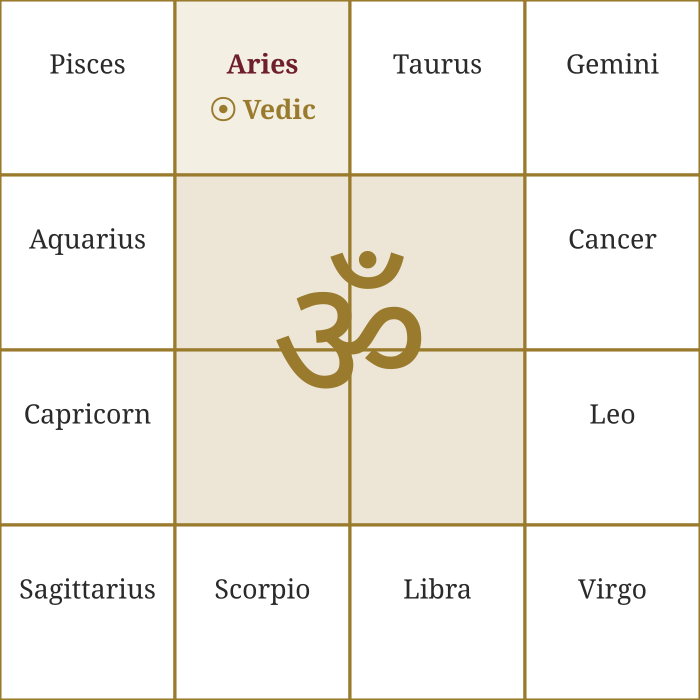 | 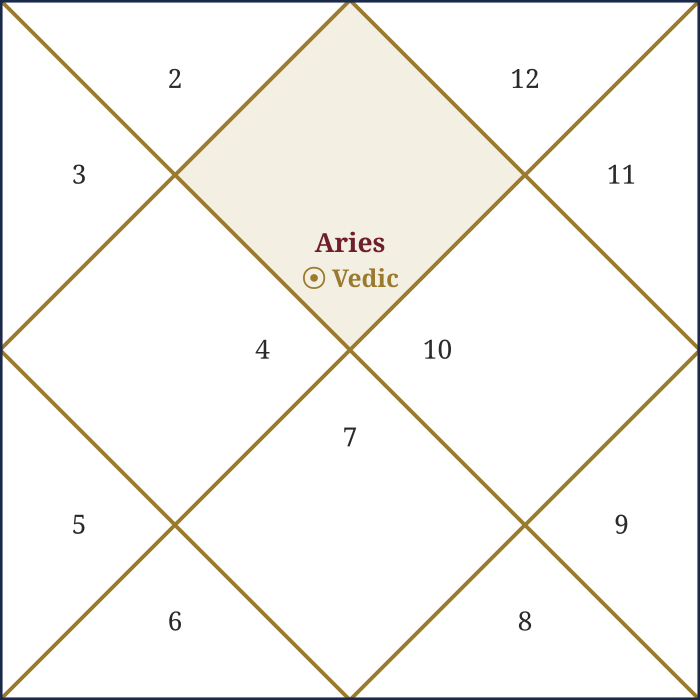 | 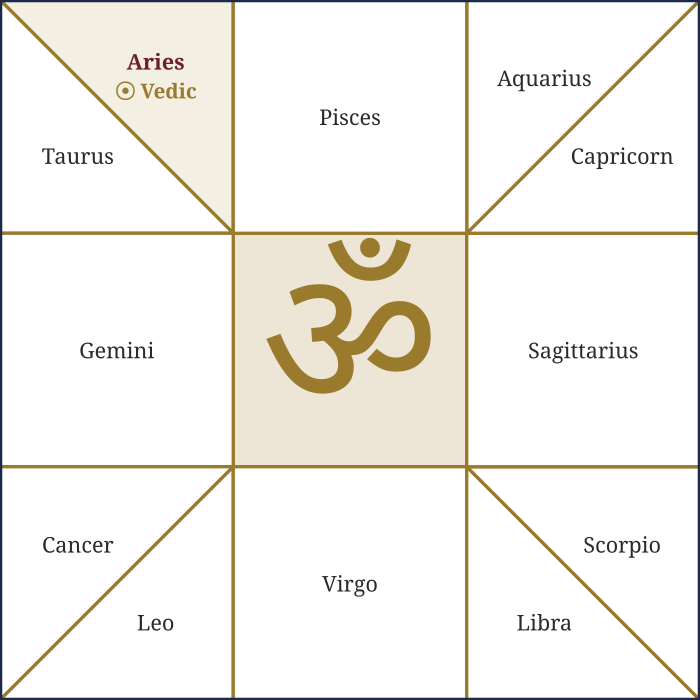 |
| South Indian (Guru Cakra) | North Indian (Śukra Cakra) | East Indian (Sūrya Cakra) |
Same information, three different visual conventions. Once you know which style you're looking at, reading any of them becomes a matter of habit rather than difficulty.
Putting It All Together
To read even a completely unfamiliar horoscope, you now have the whole basic method:
- Find the Lagna (1st house) and note its rāśi — this anchors everything else.2. Count outward from there to identify which rāśi governs each of the remaining eleven houses.3. Locate each of the nine grahas and note which rāśi and which house each one sits in.4. For each graha, combine its own basic nature (Part 3) with the flavor of the rāśi it's sitting in (Part 2) and the life-area of the house it occupies (Part 2) — that combination is the placement's core story.
None of this makes you a Jyotiṣī overnight — the deeper craft involves planetary strength, aspects, dignities, and dozens of further layers this introduction hasn't touched. But it does mean that the next time someone hands you a chart, or shows you their own, you're no longer looking at an indecipherable grid of symbols. You're looking at a structure you now know how to read.
Thoughts? Leave a Comment