Ketu in the Upapada Lagna: Sign by Sign
Why Ketu in the Upapada deserves its own study
The Upapada Lagna (UL), the ārūḍha of the 12th house, shows the marriage as it is lived. Of all the grahas that can sit there, Ketu is the most puzzling. He is a malefic, yet he is also the mokṣakāraka, the significator of liberation. He can deny a marriage, delay it, or give one bound by a shared spiritual purpose. And unlike the seven visible grahas, his strength in each sign is not agreed on by the classical authors.
This article asks a narrow question: what does Ketu in the Upapada mean in each of the twelve signs, taken in isolation? "In isolation" means reading only three things:
- Ketu himself, as a malefic and a significator of detachment.
- The sign: its lord, whether it is a benefic's or a malefic's sign, and whether it is movable, fixed or dual.
- Ketu's dignity in that sign, as far as the texts agree.
Everything else is set aside here: aspects, the 2nd from the UL, the UL lord, the Navāṁśa and the daśās. In a real chart those can confirm, soften or overturn the reading, and a later section explains how. The isolated reading is a starting point, never a verdict.
The classical texts give rules for malefics in the Upapada, but they do not give a sign-by-sign table for Ketu. The sign readings below are therefore derived from the classical principles, and they are marked as such.
What the classical texts say
Three classical rules bear directly on Ketu in the Upapada.
1. A malefic on the Upapada (BPHS 30.4–5). Parāśara describes the Upapada "joined by malefics, in a malefic's sign, aspected by malefics" (pāpagrahayute tatra pāpabhe pāpavīkṣite). The result is that the native becomes a pravrājaka, a wandering renunciate, or remains without a spouse. He adds at once that benefic aspect or conjunction prevents this (śubhadṛgyogato naiva). Ketu is a malefic, so he fulfils the first of the three conditions wherever he sits. Whether the second is fulfilled depends entirely on the sign.
2. Renunciation. Parāśara's word pravrājaka, and Jaimini's pravrajyā (1.4.2), name renunciation as an alternative to losing the spouse. Of all the malefics, Ketu is the one whose own nature is renunciation. When the texts say a malefic-afflicted Upapada can make a person a renunciate rather than a widower, Ketu is the graha most likely to deliver that form of the result.
3. Ketu's conjunctions (BPHS 30.17–19; Jaimini 1.4.13–16). Ketu with Venus in the Upapada or its 2nd points to blood disorders in the spouse. Ketu with Mercury points to weakness of the bones, or a stout build. These are not isolation readings, but they show that the texts treat Ketu in the Upapada as a real force on the spouse, not a neutral point.
Two further facts set the scale for the sign readings:
- Malefic signs. A malefic's sign (pāpabha) is one ruled by Mars, the Sun or Saturn: Aries, Leo, Scorpio, Capricorn and Aquarius. In these five signs Ketu in the Upapada already fulfils two of Parāśara's three conditions. In the seven benefics' signs (Taurus, Gemini, Cancer, Virgo, Libra, Sagittarius, Pisces), he fulfils only one.
- Gemini. The Upapada in Gemini is itself an indication of more than one marriage (BPHS 30.10; Jaimini 1.4.7), whatever occupies it.
Ketu's dignity: where the texts agree and where they do not
For the seven visible grahas, exaltation and own signs are fixed. For the nodes they are not, and the classical authors differ. Some, following a common reading of Parāśara, Sarvārtha Cintāmaṇi and Bhāvārtha Ratnākara, exalt Ketu in Scorpio and Rāhu in Taurus. Others exalt Rāhu in Gemini and Ketu in Sagittarius.
This article follows the second scheme, which is the one used in our tradition:
| Exaltation | Debilitation | Mūlatrikoṇa | Own sign | |
|---|---|---|---|---|
| Ketu | Sagittarius | Gemini | Pisces | Scorpio (co-lord with Mars) |
| Rāhu | Gemini | Sagittarius | Virgo | Aquarius (co-lord with Saturn) |
The nodes are always exactly opposite each other, so in this scheme their exaltations face each other too: Rāhu is exalted in Gemini at the very point where Ketu is debilitated, and the reverse.
Three practical conclusions follow for Ketu:
- Sagittarius is Ketu's strongest sign (exaltation), followed by Pisces (mūlatrikoṇa) and Scorpio (own sign). All three are signs of Jupiter or Mars, the dharmic and the fierce.
- Gemini is Ketu's weakest sign (debilitation). Mercury's airy, dual, talkative sign is the opposite of Ketu's silent, single-pointed nature.
- In the other seven signs Ketu is neutral, and the reading rests mainly on the sign's lord and nature.
Why this matters for the Upapada: dignity changes how strongly a graha gives its own nature, not whether that nature is pleasant. An exalted Ketu is more Ketu, not a gentler one. In the Upapada, a strong Ketu gives the most complete form of what Ketu signifies: detachment, renunciation, or a marriage held together by a shared spiritual purpose. A debilitated Ketu gives the same themes in a confused, unstable form: detachment without clarity, and breaks without peace.
Ketu in the Upapada, sign by sign
The table gives the three inputs for each sign; the notes that follow give the reading in isolation. Remember that Rāhu always sits in the 7th from the Upapada when Ketu occupies it, so the marriage always carries a matching pull in the opposite direction.
| Sign | Lord | Sign type | Benefic or malefic sign | Ketu's dignity | Isolation reading in one line |
|---|---|---|---|---|---|
| Aries | Mars | Movable | Malefic | Neutral | Sudden bonds and sudden breaks; marriage around a shared mission |
| Taurus | Venus | Fixed | Benefic | Neutral | Stable form, little inner satisfaction |
| Gemini | Mercury | Dual | Benefic | Debilitated | Doubt and repetition; Gemini itself signals more than one marriage |
| Cancer | Moon | Movable | Benefic | Neutral | Emotional distance inside a caring home |
| Leo | Sun | Fixed | Malefic | Neutral | Pride and principle; marriage to a dharmic cause |
| Virgo | Mercury | Dual | Benefic | Neutral | Marriage of service and duty, critical and exacting |
| Libra | Venus | Movable | Benefic | Neutral | Indifference to romance; partnership on ideals |
| Scorpio | Mars (and Ketu) | Fixed | Malefic | Own sign | Delay, denial or renunciation; if it forms, a deep karmic bond |
| Sagittarius | Jupiter | Dual | Benefic | Exalted | Marriage within a shared faith or lineage; the strongest Ketu |
| Capricorn | Saturn | Movable | Malefic | Neutral | Late, dutiful, emotionally reserved |
| Aquarius | Saturn (and Rāhu) | Fixed | Malefic | Neutral | Unconventional bond; detachment for a collective cause |
| Pisces | Jupiter | Dual | Benefic | Mūlatrikoṇa | Spiritual union, or renunciation |
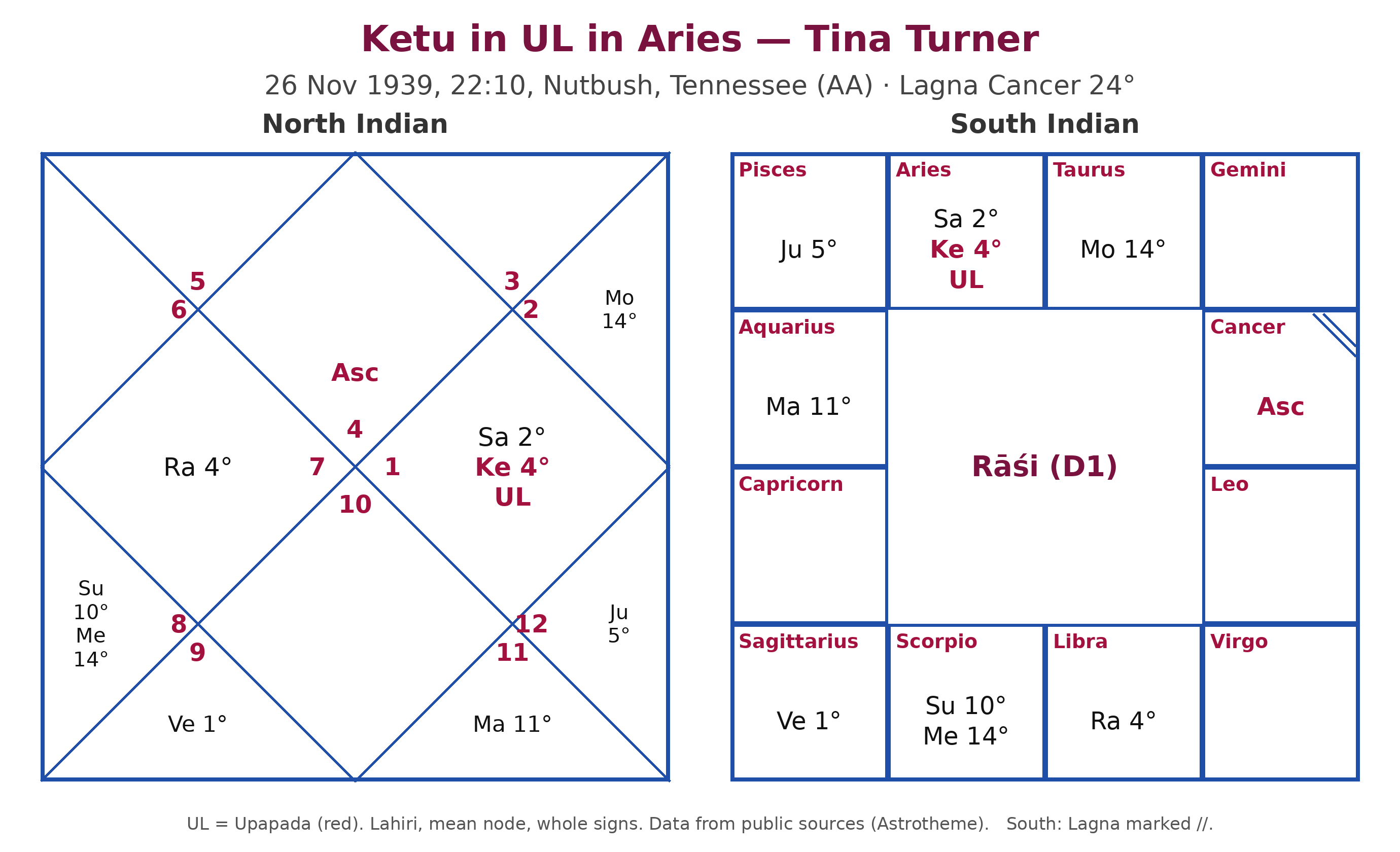
Aries. Ketu in a fiery, movable sign of Mars acts quickly and fiercely. The marriage often forms fast, around shared work or a common goal, and can end just as fast. As a malefic in a malefic's sign, Ketu already meets two of Parāśara's three conditions, so without benefic support the risk of separation is real.
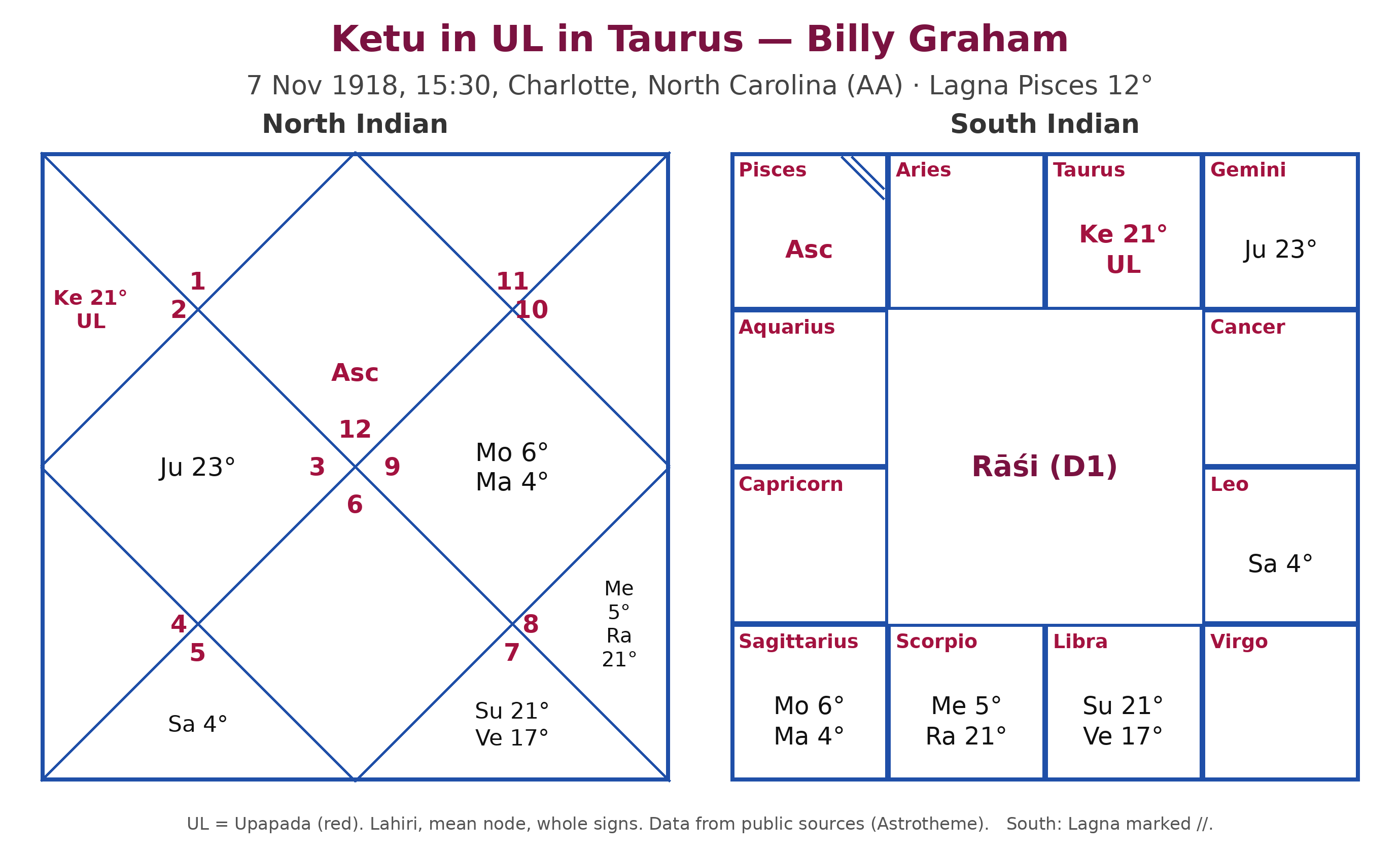
Taurus. In Venus's earthy, fixed sign Ketu is neutral, but his nature runs against the sign's love of comfort and possession. The marriage tends to keep its outward form, home, routine and property, while one partner feels detached from its pleasures. The benefic sign keeps the structure standing.
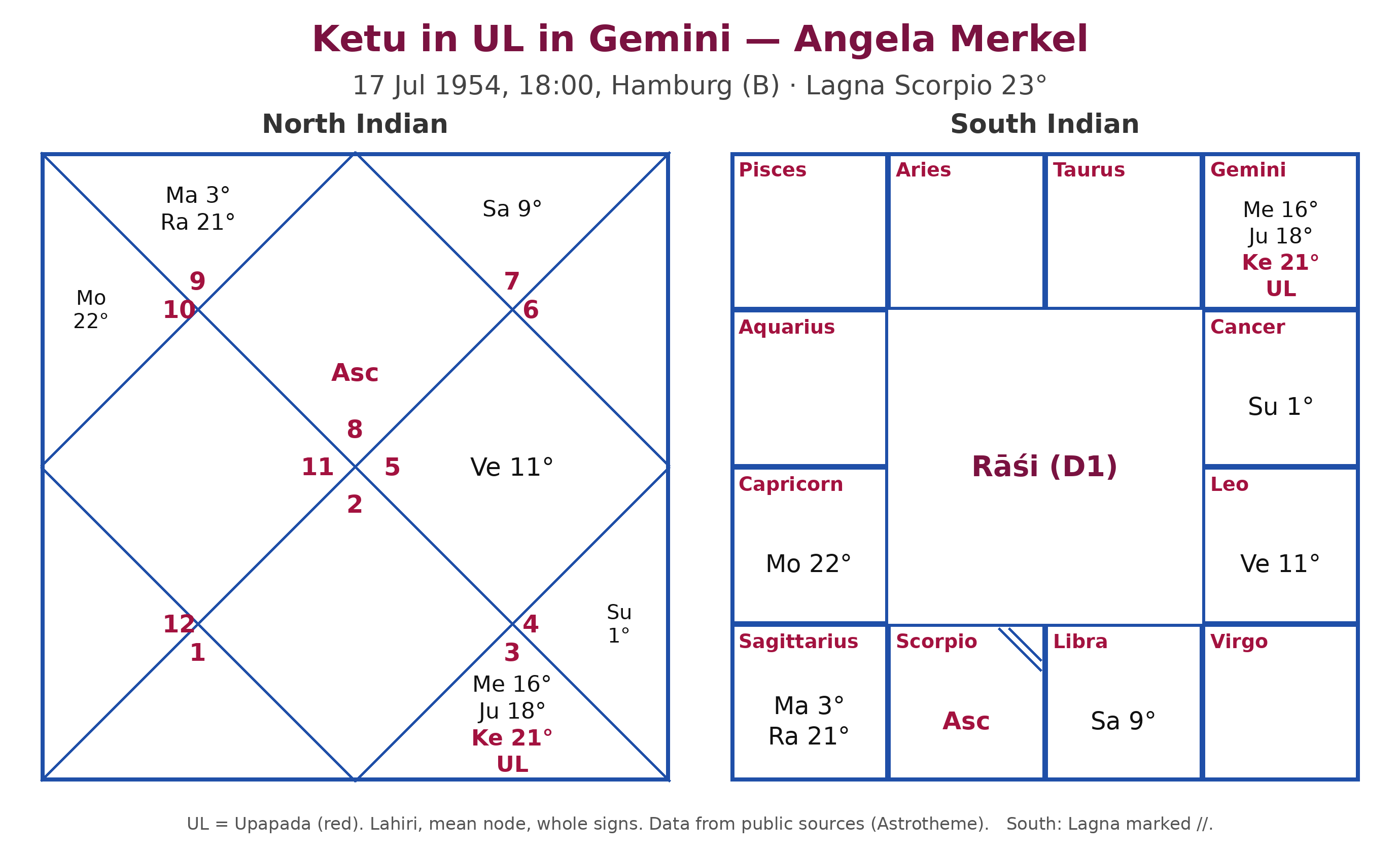
Gemini. Two signals combine. The Upapada in Gemini itself indicates more than one marriage (BPHS 30.10), and Ketu is debilitated here, opposite his exaltation in Sagittarius. A debilitated Ketu does not give clean renunciation; he gives doubt, restlessness and second thoughts. In isolation this is the placement most likely to give a broken first marriage followed by another.
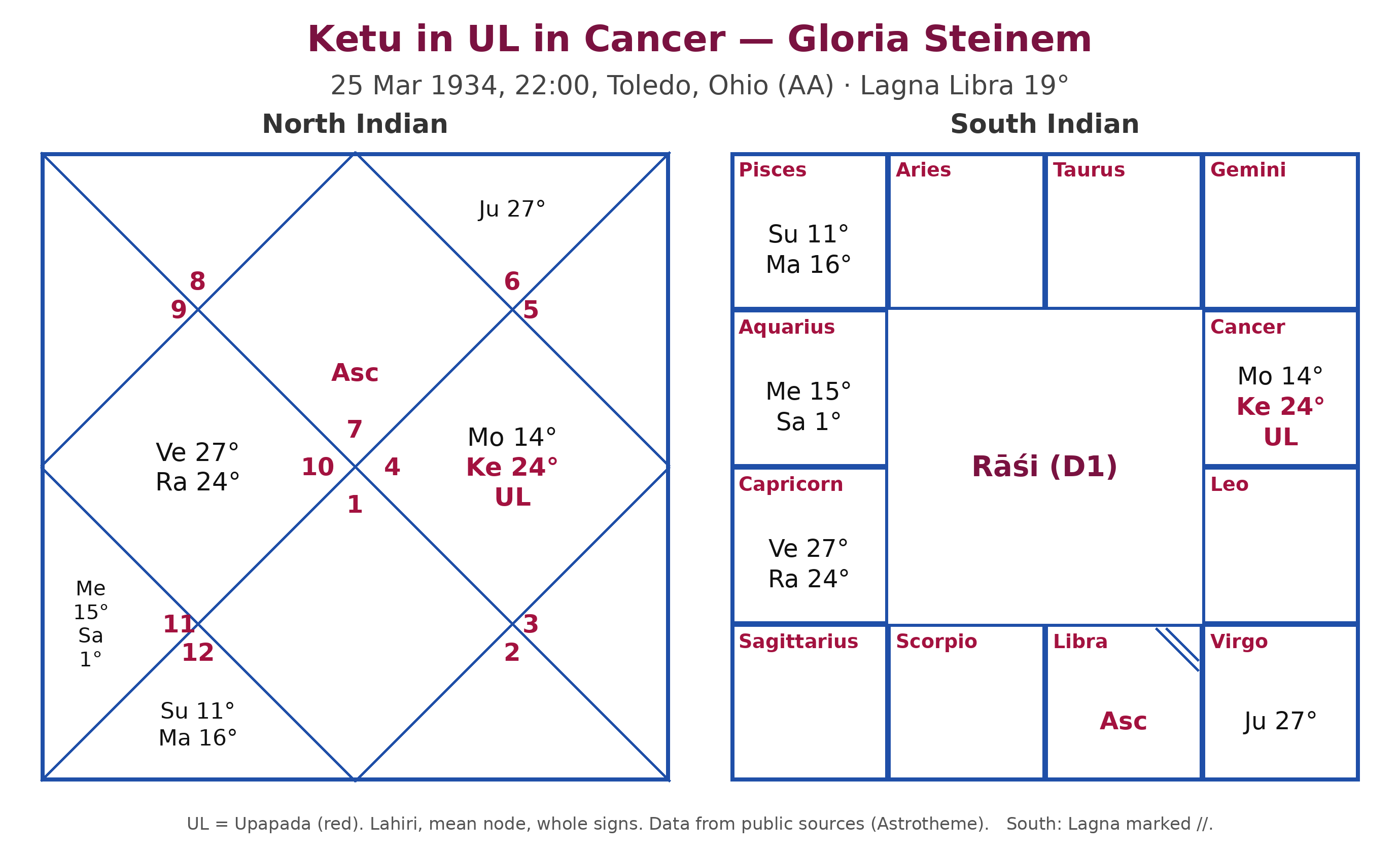
Cancer. Ketu in the Moon's sign separates the person from emotional need. The home is cared for, but feelings are held back, and the spouse may feel they are married to someone who is never quite present.
Leo. In the Sun's royal, fixed sign, Ketu gives a marriage shaped by pride, principle or public duty. The spouse may be married to a calling as much as to the native. It is a malefic's sign, so the two-condition caution applies.
Virgo. Mercury's dual, earthy sign makes the marriage a matter of service and practical duty. Ketu sharpens Virgo's criticism, which can wear the bond down. Virgo is also Rāhu's mūlatrikoṇa, and with Ketu here Rāhu sits in Pisces, so the marriage may be pulled between practical duty and a partner's idealism.
Libra. Ketu in the natural sign of partnership shows indifference to conventional romance and social expectation. The bond works best when both partners share ideals rather than seek ordinary companionship.
Scorpio. Ketu is in his own sign, as co-lord with Mars, so he gives his nature strongly. It is also a malefic's sign, so two of Parāśara's three conditions are met. Taken in isolation, this is a strong classical picture of Parāśara's pravrājaka or dārahīna: late marriage, no marriage, or a deliberate turn to the inner life. When a marriage does form, it is deep, private and karmic. And because Ketu co-rules the sign, he is effectively the Upapada lord sitting in the Upapada, which gives the bond great endurance once made.
Sagittarius. Ketu is exalted here, at his strongest, in Jupiter's dharmic, benefic sign. Only one of Parāśara's conditions is met, so the detachment does not destroy the marriage; it lifts it. The bond is held together by a shared faith, a teacher or a tradition, and the couple's dharma comes before personal pleasure. This is the most favourable sign for Ketu in the Upapada. The caution is that an exalted Ketu can also make renunciation itself the higher calling.
Capricorn. In Saturn's movable sign Ketu adds detachment to duty. The marriage comes late or is formed for practical reasons, and warmth has to be built over time. Two of Parāśara's conditions are met here too.
Aquarius. Aquarius is Saturn's sign and is co-ruled by Rāhu, so Ketu sits in his opposite node's sign. The bond is unconventional: across backgrounds, or for a shared social cause. Detachment comes from the pull of the community rather than personal coldness.
Pisces. Ketu is in his mūlatrikoṇa in Jupiter's sign of liberation, so he is strong and comfortable. In isolation it gives either a spiritual union, a marriage that is itself a sādhanā, or a turn away from marriage altogether. The benefic sign tilts it toward the first.
Is Ketu in Scorpio or Pisces the same as Ketu in Gemini?
No. All three are Ketu in the Upapada, but they differ on every one of the three inputs, and the results move in different directions. Sagittarius, Ketu's exaltation, is added for comparison.
| Scorpio | Pisces | Sagittarius | Gemini | |
|---|---|---|---|---|
| Ketu's dignity | Own sign | Mūlatrikoṇa | Exalted | Debilitated |
| Sign | Malefic's sign (Mars) | Benefic's sign (Jupiter) | Benefic's sign (Jupiter) | Benefic's sign (Mercury) |
| Parāśara's conditions met in isolation | Two of three | One of three | One of three | One of three |
| Special classical rule | — | — | — | Gemini UL gives more than one marriage (BPHS 30.10) |
| Typical isolation result | Delay, denial or renunciation; if formed, a deep bond that endures | A spiritual marriage, or a turn away from marriage | A marriage bound by shared dharma | A first marriage that breaks, and another |
Scorpio and Pisces are related, but not identical. In both, Ketu is dignified and gives his own nature fully. In Scorpio that nature lands in a malefic, fixed, secretive sign of Mars, so detachment shows as delay, withdrawal or denial. In Pisces it lands in Jupiter's benefic sign of liberation, so it shows as spiritual union, or as a calm choice of the inner life over marriage. Scorpio is the harder placement for a marriage to happen; Pisces is the gentler one.
Gemini is the opposite case. Ketu is debilitated there, so he does not give clean renunciation or a calm spiritual bond. Instead he unsettles a sign that the texts already associate with more than one marriage. The problem is not that marriage is denied, but that it does not stay single.
In short:
- Scorpio: marriage is hard to begin.
- Pisces: marriage is spiritualised, or set aside by choice.
- Sagittarius: marriage is lifted by a shared dharma.
- Gemini: marriage begins easily and repeats.
Twelve examples from known horoscopes
One chart is given for each sign, all with Ketu in the Upapada. Charts are cast in the sidereal zodiac (Lahiri ayanāṁśa, mean node, whole-sign houses). Birth data and its Rodden reliability rating are as given on Astrotheme; AA means a birth certificate or birth record. Where a chart is weaker, that is said.
These are illustrations, not proofs. Each life is read here only against the isolation reading for its sign; aspects, the 2nd from the UL and the daśās (see the next section) decide the details in each case.
A note on the data. The birth dates, times and places below are taken from public sources (chiefly the Astrotheme database, with its Rodden ratings), and the marriage histories from published biographies and news reports. They have not been checked against original records by the author. The charts are the author's own calculations from that data, offered for study only; a different birth time, ayanāṁśa or node setting can change the Lagna and with it the Upapada. Nothing here is a reading of, or a comment on, any person's private life.
Aries — Tina Turner. 26 November 1939, 22:10, Nutbush, Tennessee (AA). Lagna Cancer; the 12th is Gemini, whose lord Mercury is in Scorpio, 6 signs on, so the UL falls 6 signs from Scorpio, in Aries, where Ketu sits. Her first marriage, to Ike Turner (1962), was built around their joint stage act and ended with her sudden departure in 1976 and divorce in 1978. She married Erwin Bach in 2013, after 27 years together. This is the Aries pattern: a bond built on shared work, broken sharply.
Taurus — Billy Graham. 7 November 1918, 15:30, Charlotte, North Carolina (AA). Lagna Pisces; the 12th is Aquarius, co-ruled by Saturn and Rāhu. Saturn is alone in Leo; Rāhu is with Mercury in Scorpio, so Rāhu is the stronger lord (Jaimini's rule of more conjunctions). The count lands in Leo, the 7th from Aquarius, so by the exception the UL moves to the 10th from Leo: Taurus, with Ketu. He was married to Ruth Bell from 1943 until her death in 2007, 64 years, much of it spent apart on his crusades. The Taurus pattern: the form of the marriage stands firm while one partner's attention is elsewhere.
Gemini — Angela Merkel. 17 July 1954, 18:00, Hamburg (B: from a biography rather than a record). Lagna Scorpio; the 12th is Libra, lord Venus in Leo, so the UL is Gemini, with Ketu debilitated there. She married Ulrich Merkel in 1977 and divorced in 1982; she married Joachim Sauer in 1998. A first marriage that breaks and a second that holds: the Gemini reading exactly.
Cancer — Gloria Steinem. 25 March 1934, 22:00, Toledo, Ohio (AA). Lagna Libra; the 12th is Virgo, lord Mercury in Aquarius, so the UL is Cancer, with Ketu. For decades she said publicly that marriage was not for her, and she first married at 66, in 2000, to David Bale, who died in 2003. Emotional independence held for most of a lifetime, then a late and caring bond.
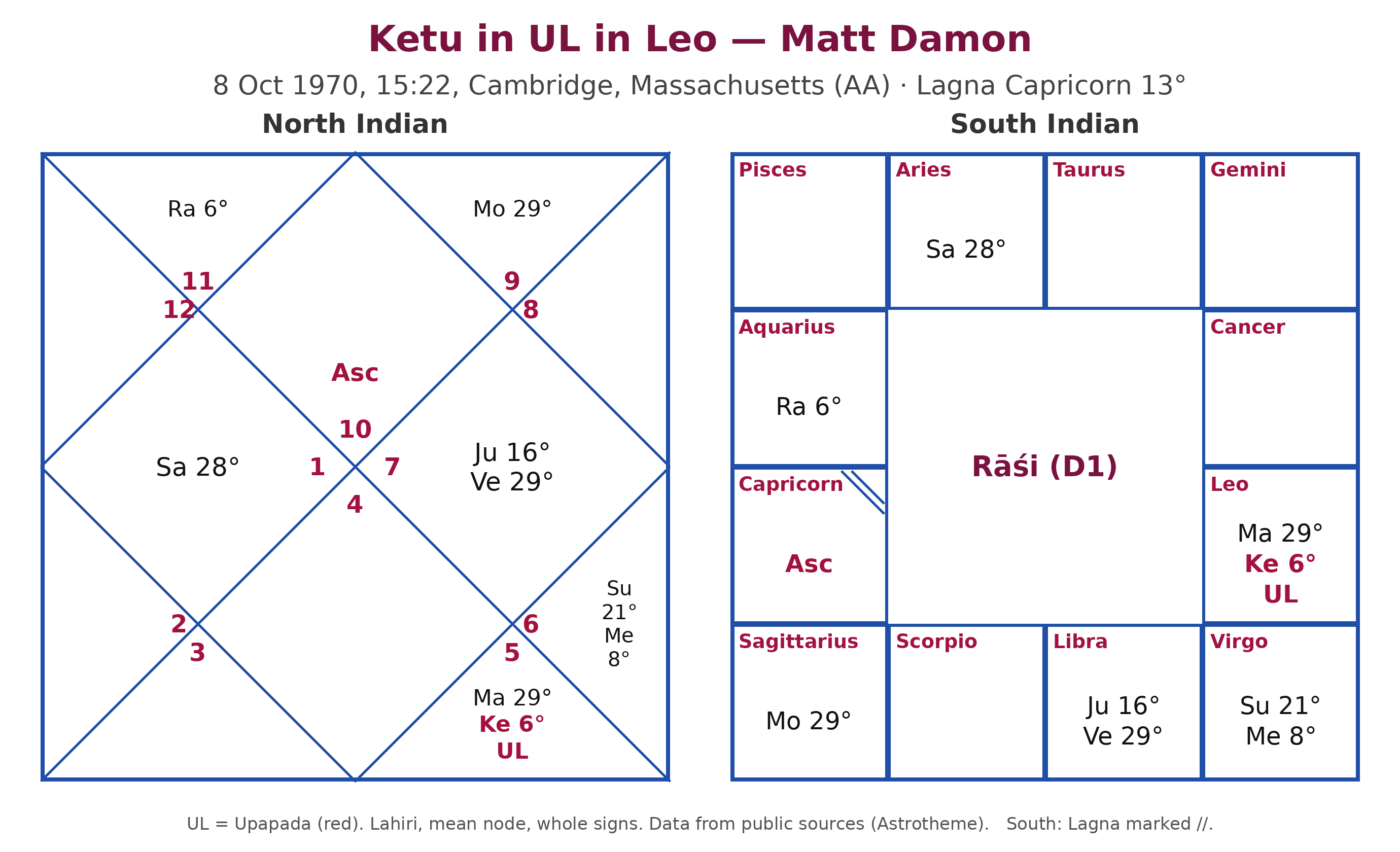
Leo — Matt Damon. 8 October 1970, 15:22, Cambridge, Massachusetts (AA). Lagna Capricorn; the 12th is Sagittarius, lord Jupiter in Libra, so the UL is Leo, with Ketu. He married Luciana Barroso in 2005, at 34, and the marriage has lasted. Leo shows the caution, not a verdict: two of Parāśara's conditions are met, but they never act alone, and the next section shows what else to check.
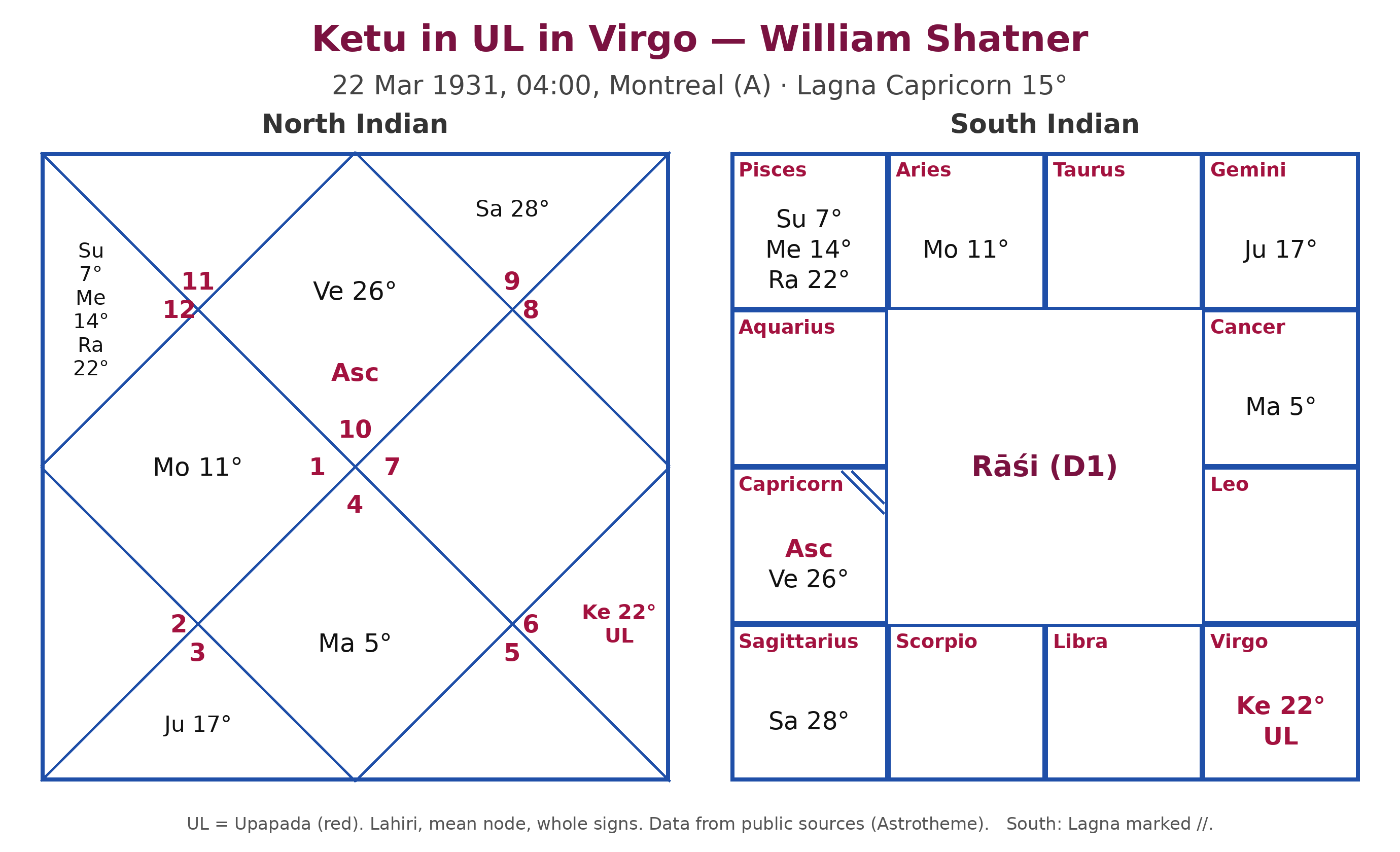
Virgo — William Shatner. 22 March 1931, 04:00, Montreal (A). Lagna Capricorn; the 12th is Sagittarius, lord Jupiter in Gemini. The count lands back on Sagittarius itself, so by the exception the UL is the 10th from it: Virgo, with Ketu. He has married four times: Gloria Rand (1956–1969), Marcy Lafferty (1973–1996), Nerine Kidd (1997, until her death in 1999) and Elizabeth Martin (2001–2020). Virgo is a dual sign, and the dual signs repeat.
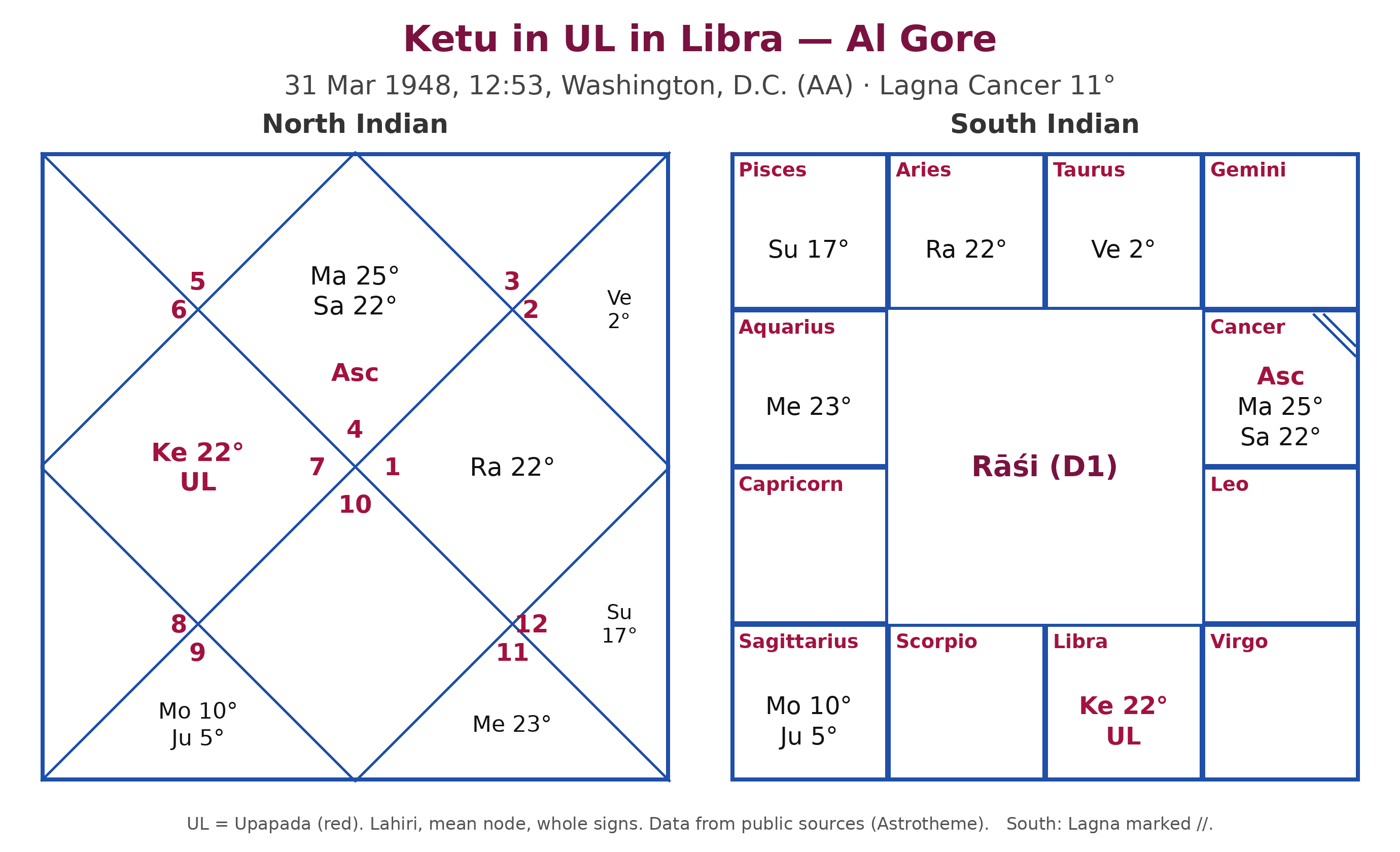
Libra — Al Gore. 31 March 1948, 12:53, Washington, D.C. (AA). Lagna Cancer; the 12th is Gemini, lord Mercury in Aquarius, so the UL is Libra, with Ketu. He married Tipper Aitcheson in 1970; they announced their separation in 2010, after 40 years, without a public quarrel. A partnership of ideals and public life that ended quietly rather than in conflict.
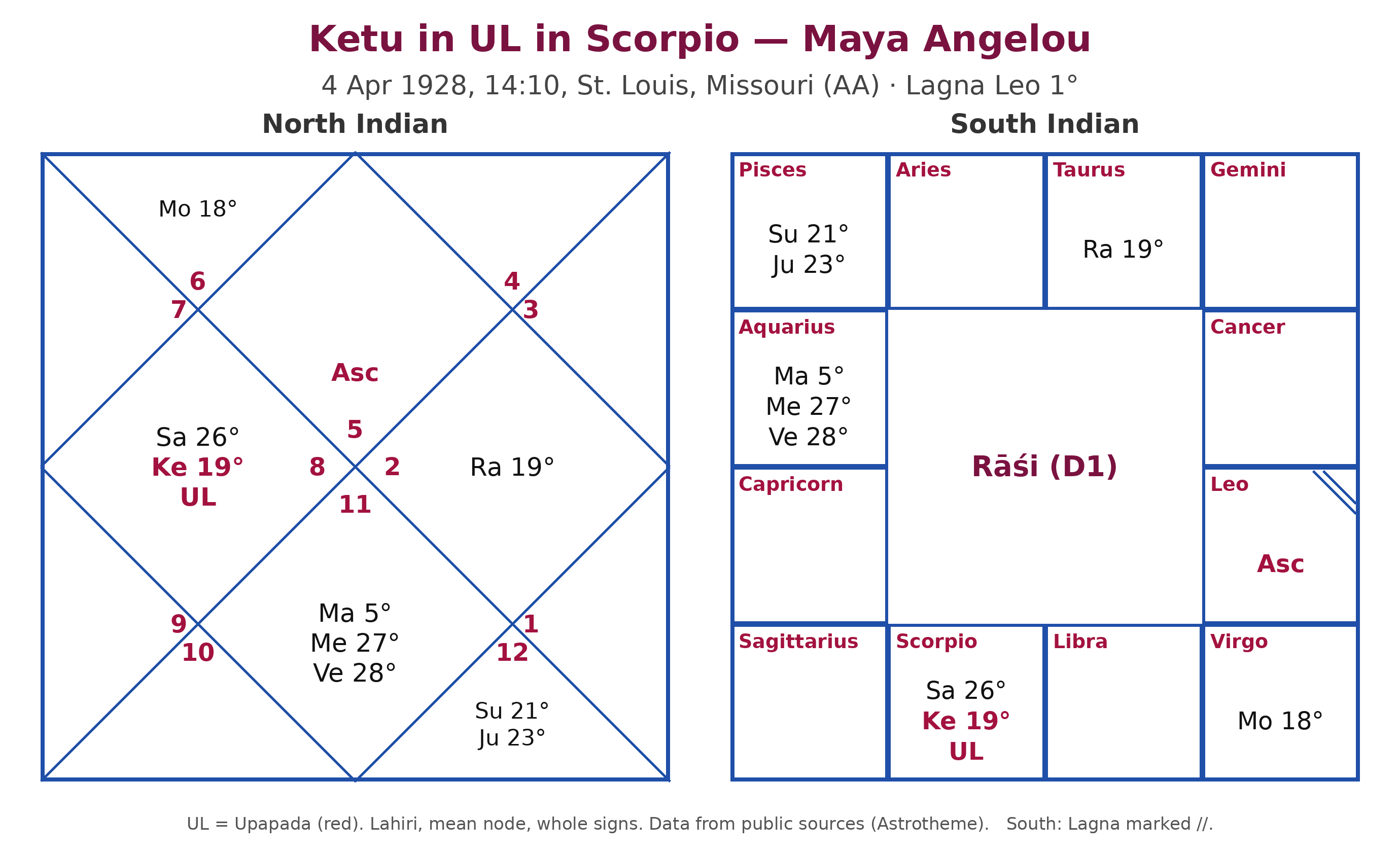
Scorpio — Maya Angelou. 4 April 1928, 14:10, St. Louis, Missouri (AA). Lagna Leo at 1°; the 12th is Cancer, lord Moon in Virgo, so the UL is Scorpio, with Ketu in his own sign. Her marriages were brief (to Tosh Angelos in the early 1950s, and to Paul du Feu, 1973–1981), and she spent most of her adult life unmarried. Caution: the Lagna is only one degree into Leo. A birth about twenty minutes earlier gives a Cancer Lagna and a different UL, so this example depends on the exact recorded minute.
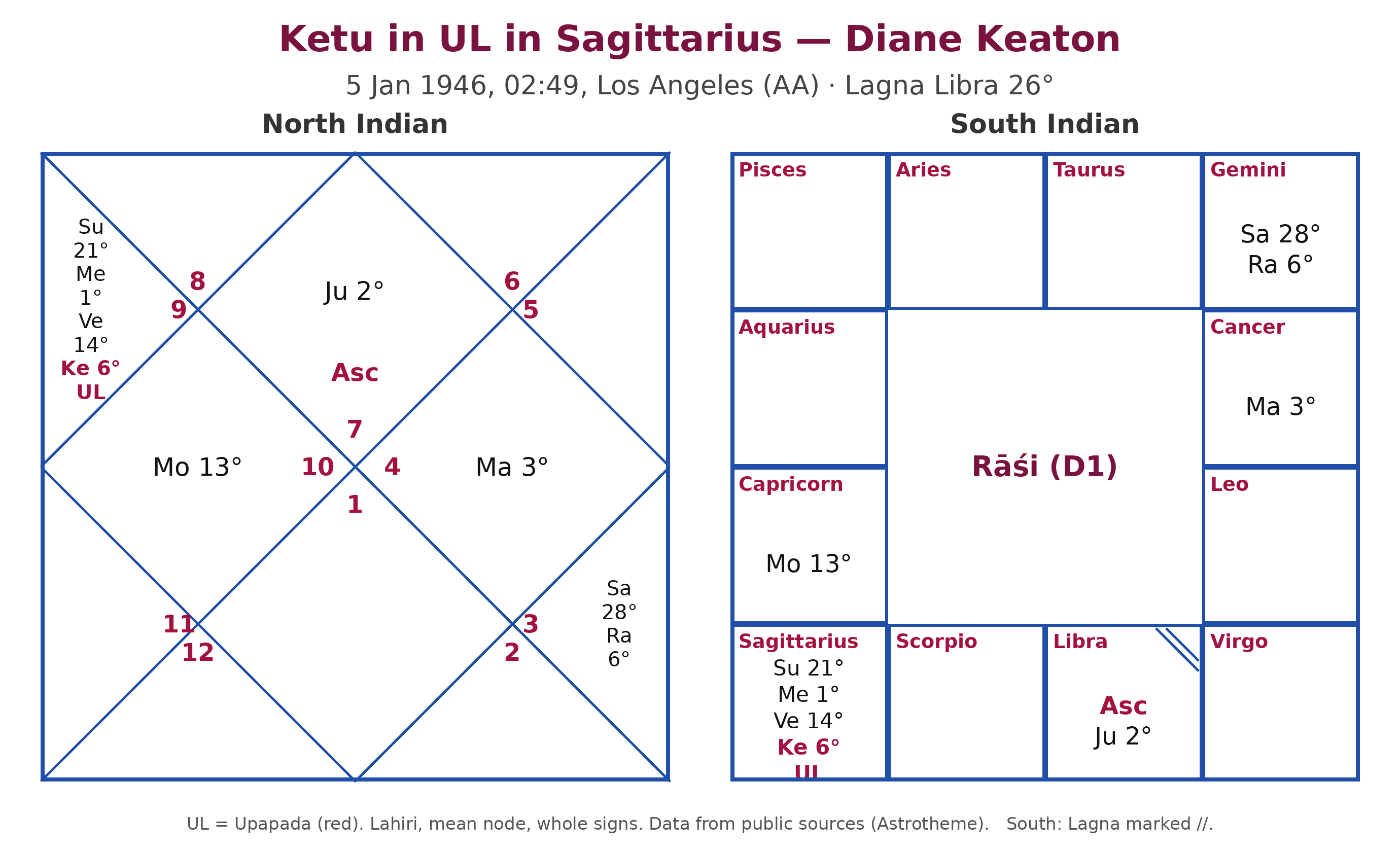
Sagittarius — Diane Keaton. 5 January 1946, 02:49, Los Angeles (AA). Lagna Libra; the 12th is Virgo, lord Mercury in Sagittarius. The count lands in Pisces, the 7th from Virgo, so by the exception the UL is the 10th from Pisces: Sagittarius, with Ketu exalted. She never married, by her own account by choice, though she had long relationships and adopted two children. This is the caution in the Sagittarius reading: an exalted Ketu can make independence itself the higher calling.
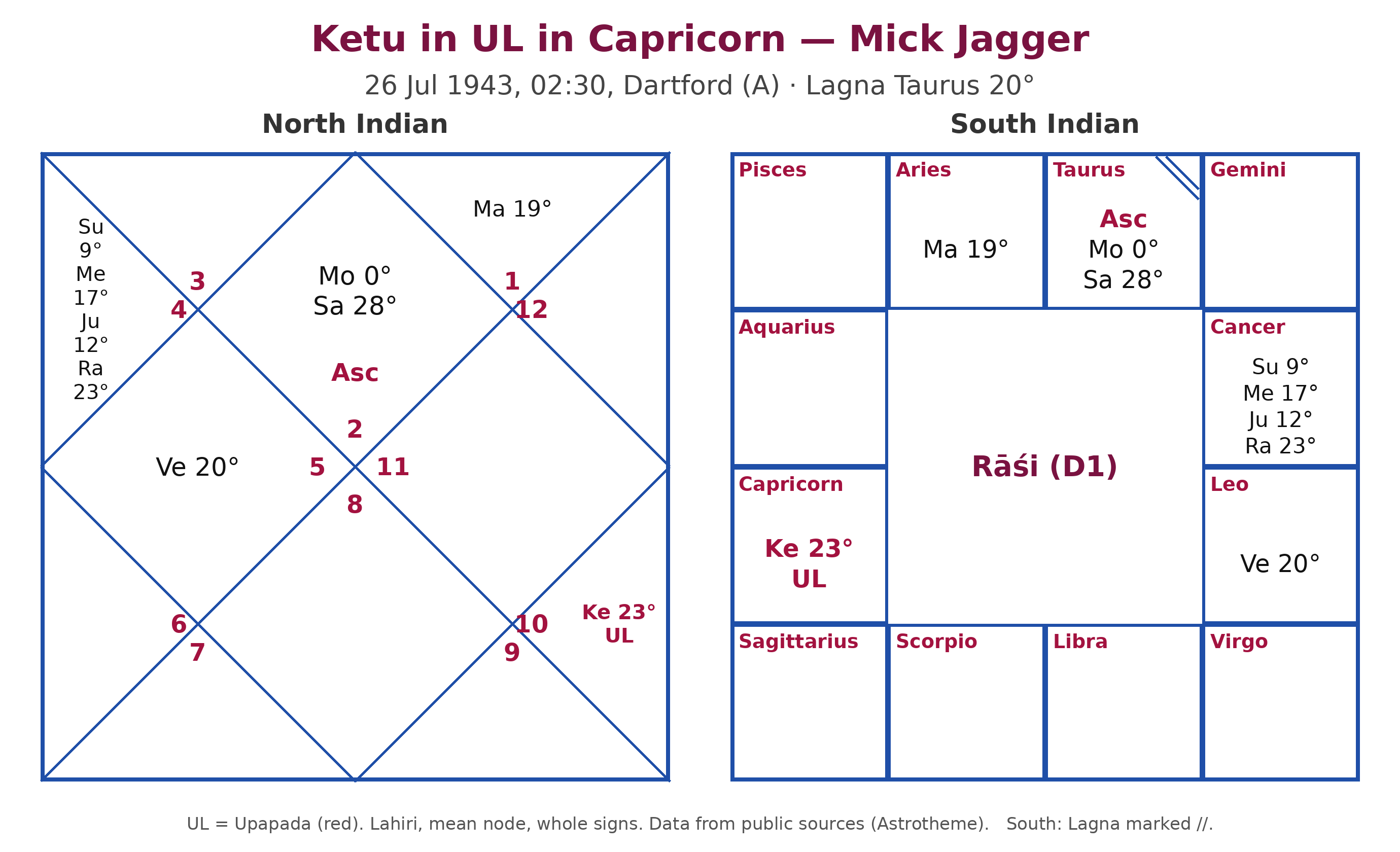
Capricorn — Mick Jagger. 26 July 1943, 02:30, Dartford, England (A: from memory). Lagna Taurus; the 12th is Aries, and its lord Mars sits in Aries. The lord in its own house sends the UL to the 10th from it: Capricorn, with Ketu. He married Bianca Pérez-Mora in 1971 (divorced 1978); his 1990 ceremony with Jerry Hall was later declared not legally valid. Long partnerships, few binding marriages: Saturn's sign keeping commitment at a distance.
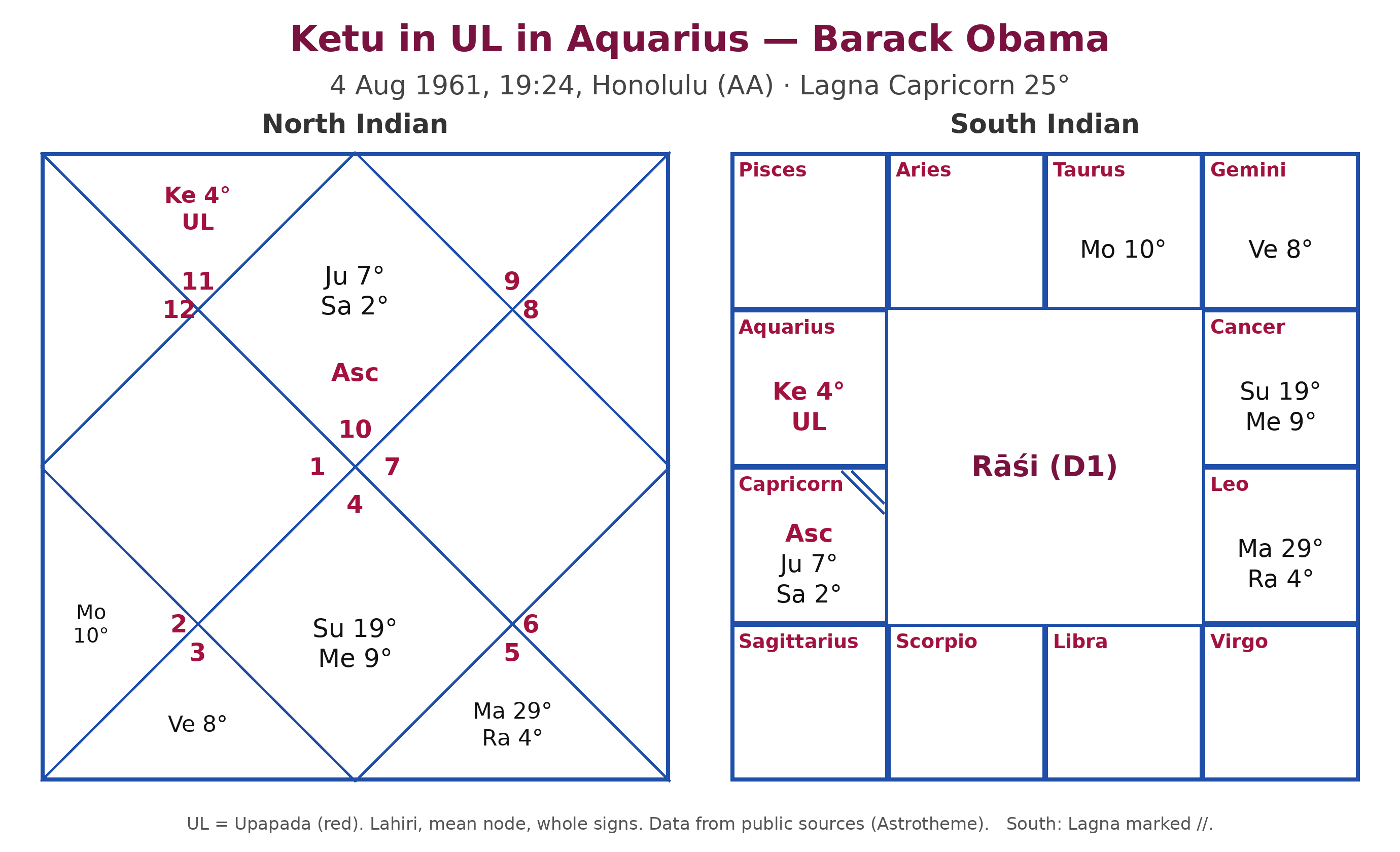
Aquarius — Barack Obama. 4 August 1961, 19:24, Honolulu (AA). Lagna Capricorn; the 12th is Sagittarius, lord Jupiter in Capricorn, so the UL is Aquarius, with Ketu. He married Michelle Robinson in 1992 and the marriage has lasted. The bond crosses backgrounds and was built around public service, the Aquarius reading in its positive form.
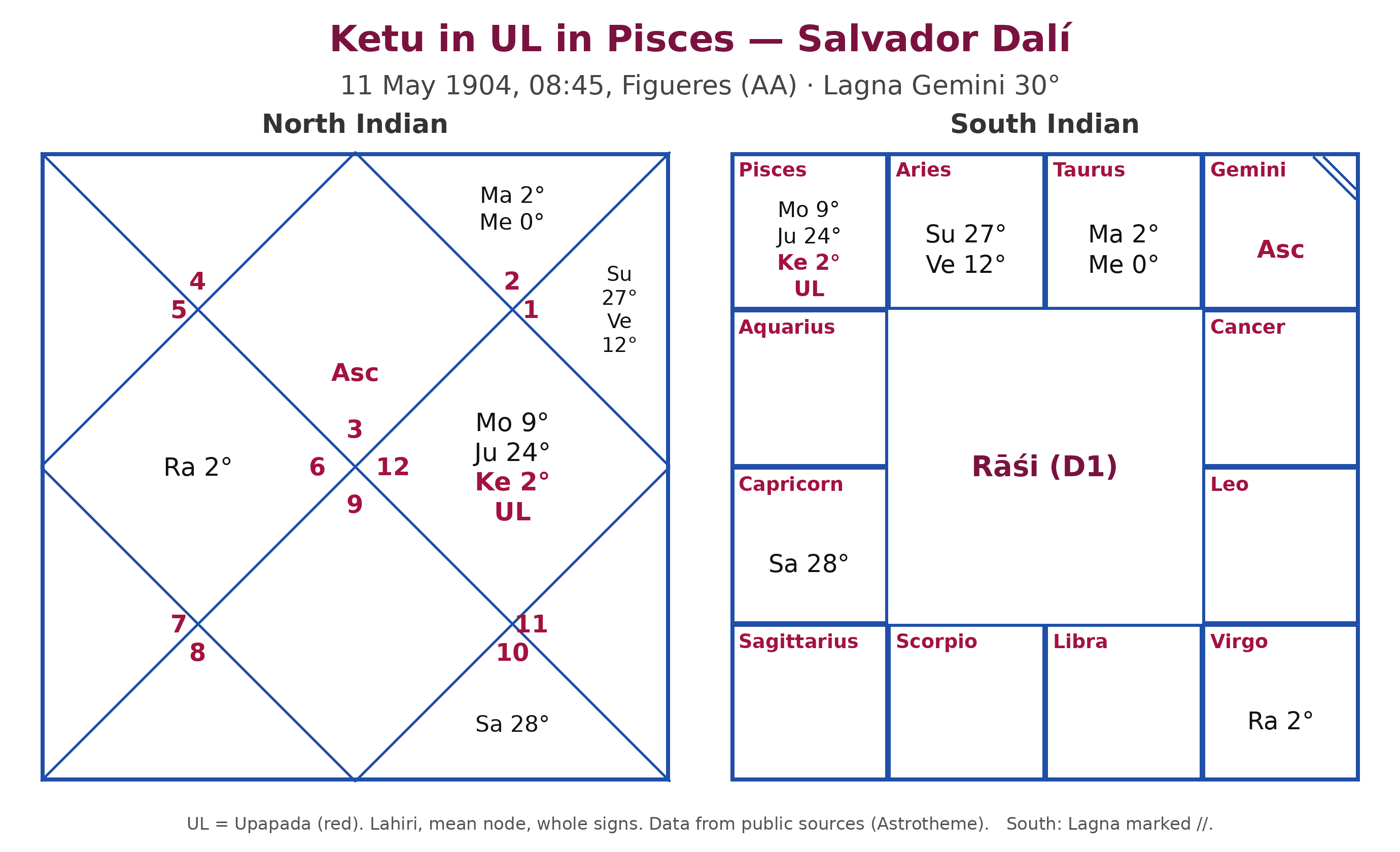
Pisces — Salvador Dalí. 11 May 1904, 08:45, Figueres, Spain (AA). Lagna Gemini; the 12th is Taurus, lord Venus in Aries, so the UL is Pisces, with Ketu in his mūlatrikoṇa. He met Gala in 1929, married her in 1934 and again in church in 1958, and stayed with her until her death in 1982. She was his muse and model: a marriage that was itself bound up with his art. Caution: the Lagna is at 29°40′ Gemini. A birth a few minutes later gives a Cancer Lagna and a different UL.
Two patterns stand out. The dual signs (Gemini, Virgo) give repeated marriages, as the texts say. The malefic signs (Aries, Leo, Scorpio, Capricorn) show the whole range, from sharp breaks to long marriages, which is why the next section matters.
Beyond isolation
No chart has Ketu in the Upapada and nothing else. Before reading any of the above into a real chart, check these, in roughly this order:
- Benefic aspect on the Upapada. Parāśara's own exception (BPHS 30.5): a benefic joining or aspecting the UL prevents the loss of the spouse. Even Ketu in Scorpio is transformed by it.
- The 2nd from the Upapada. The Upapada shows whether a marriage forms; the 2nd from it shows whether it lasts (Jaimini 1.4.2–8). A Ketu-afflicted UL with a strong, benefic 2nd can mean a marriage that is late to begin but holds firmly once made.
- The Upapada lord. Its dignity shows the quality of the spouse (BPHS 30.14). Where Ketu co-rules the sign (Scorpio), the lord's condition matters doubly.
- The daśās. Ketu's own periods, and those of the Upapada lord, are when the indications of Ketu in the UL ripen. A long daśā of Rāhu, who always sits in the 7th from such an Upapada, can hold the marriage question open for years.
- The Navāṁśa. Ketu's sign and company in the D9 confirm or reverse the rāśi reading.
Read this way, Ketu in the Upapada is not a sentence of loneliness. It describes the kind of marriage the soul is ready for: one that serves a purpose larger than the two people in it, or none at all until such a purpose appears.
Further research needed
This study is a beginning, not a conclusion. The classical texts give no sign-by-sign rules for Ketu in the Upapada, the authorities disagree on Ketu's dignities, and twelve charts, one per sign, are far too few to establish any pattern. A great deal more research is needed: many more well-timed charts for each sign, charts of people whose marriages are known in detail rather than only from public reports, and a careful look at how aspects, the 2nd from the UL and the daśās change the result. Readers who have verified charts with Ketu in the Upapada are warmly invited to share them, so that these readings can be tested and refined.
Sources
- Bṛhat Parāśara Horā Śāstra, chapter 30 (Upapadādhyāya), especially verses 4–5, 10 and 17–19, Santhanam numbering; chapter 3 on graha dignities.
- Jaimini Upadeśa Sūtras 1.4.2–8 and 1.4.13–16.
- On Ketu's dignities, this article follows the scheme that exalts Ketu in Sagittarius and Rāhu in Gemini, with Ketu's mūlatrikoṇa in Pisces and own sign in Scorpio. Other authorities, including Parāśara as commonly read, Sarvārtha Cintāmaṇi and Bhāvārtha Ratnākara, exalt Ketu in Scorpio instead.
- The sign-by-sign readings are derived by the author from the classical principles above; they are not quoted from any single text.
- Birth data for the example charts: Astrotheme (astrotheme.com), with Rodden ratings as shown there.
Thoughts? Leave a Comment