Upapada Lagna: The Marriage Pada in the Classical Texts
What the Upapada is
The Upapada Lagna (UL) is the ārūḍha, or "image", of the 12th house. Where the 7th house shows the spouse as a person, the Upapada shows the marriage as it is actually lived: whether it is formed, how it is sustained, and whether it breaks. Both great sources of Jyotiṣa teach it, and they agree closely.
- Parāśara gives it a full chapter in the Bṛhat Parāśara Horā Śāstra, the Upapadādhyāya (chapter 30 in the Santhanam edition; chapter 32 in Girish Chand Sharma's). The chapter covers the spouse, then children, then siblings.
- Jaimini gives it the opening sūtras of the fourth pāda of the first chapter of the Upadeśa Sūtras (1.4.1 to about 1.4.22 for marriage), following Parāśara almost point for point.
Parāśara opens the chapter by stating its purpose:
अथोपपदमाश्रित्य कथयामि फलं द्विज । युच्छुभत्वे भवेन्नृणां पुत्रदारादिजं सुखम् ॥ BPHS 30.1
athopapadam āśritya kathayāmi phalaṃ dvija / yac chubhatve bhaven nṛṇāṃ putradārādijaṃ sukham
"Now, O twice-born, I shall describe the results based on the Upapada. When it is auspicious, people enjoy happiness from children, spouse and the like."
This article sets out only what the classical texts say: how to calculate the Upapada, the rules for the Upapada and the 2nd house from it, and what the texts say about more than one marriage. Translations are my own. Where later practice goes beyond the texts, that is marked.
How to calculate the Upapada
Which house
Both texts define the Upapada as the pada of the house that "follows" the Lagna, that is, the house immediately behind it: the 12th.
तनुभावपदं विप्र प्रधानं पदमुच्यते । तनोरनुचराद्यत् स्यादुपारूढं तदुच्यते ॥ BPHS 30.2
tanubhāvapadaṃ vipra pradhānaṃ padam ucyate / tanor anucarād yat syād upārūḍhaṃ tad ucyate
"The pada of the Lagna, O Brahmin, is called the principal pada. The pada of the house that follows the Lagna is called the Upārūḍha."
The next verse adds that this is also called the Upapada or the gauṇa (secondary) pada. Jaimini's opening sūtra says the same in four words:
उपपदं पदं पित्रनुचरात् ॥ Jaimini 1.4.1
upapadaṃ padaṃ pitranucarāt
The counting rule
The pada of any house is found by Parāśara's general rule (BPHS 29.2): count from the house to the sign occupied by its lord, then count the same number of signs again from the lord. Applied to the 12th house:
- Find the lord of the 12th house.
- Count from the 12th house to the sign where that lord sits (counting the 12th itself as one).
- Count the same number again, starting from the lord's sign.
- The sign you reach is the Upapada.
The two exceptions
Parāśara forbids the pada from falling in the house itself or in the 7th from it:
स्वस्थानं सप्तमं नैवं पदं भवितुमर्हति । तस्मिन् पदत्वे विज्ञेयं मध्यं तुर्यं क्रमात् पदम् ॥ BPHS 29.4
svasthānaṃ saptamaṃ naivaṃ padaṃ bhavitum arhati / tasmin padatve vijñeyaṃ madhyaṃ turyaṃ kramāt padam
"The house itself and the 7th from it cannot be the pada. When the count falls there, know the pada to be the 10th (madhya) and the 4th (turya) respectively."
The following verse (29.5) gives the practical form: if the lord sits in the 4th from the house, the 4th itself is the pada; if the lord sits in the 7th, the 10th is the pada. For the Upapada this means:
| Where the 12th lord sits | Plain count gives | Take instead |
|---|---|---|
| In the 12th itself | The 12th | The 10th from the 12th (the 9th house) |
| In the 7th from the 12th (the 6th house) | The 12th | The 10th from the 12th (the 9th house) |
| In the 4th from the 12th (the 3rd house) | The 7th from the 12th (the 6th house) | The 4th from the 12th (the 3rd house) |
| In the 10th from the 12th (the 9th house) | The 7th from the 12th (the 6th house) | The 4th from the 12th (the 3rd house) |
Worked examples
- Taurus Lagna. The 12th is Aries; its lord Mars is in Leo, the 5th sign from Aries. Five signs from Leo is Sagittarius. UL = Sagittarius.
- Virgo Lagna, Sun in Leo. The 12th is Leo and its lord is in Leo itself, so the count returns to Leo. By the exception, take the 10th from Leo: UL = Taurus.
- Cancer Lagna, Mercury in Sagittarius. The 12th is Gemini; its lord is in the 7th from it, so the count returns to Gemini. Take the 10th from Gemini: UL = Pisces.
- Aries Lagna, Jupiter in Gemini. The 12th is Pisces; its lord is in the 4th from it, so the count reaches Virgo, the 7th from Pisces. Take the 4th from Pisces instead: UL = Gemini.
For Scorpio and Aquarius, which have two lords, practitioners generally take the stronger of the two; the chapter itself does not address this case.
The Upapada and the 2nd from it
The classical rules work on two places: the Upapada sign itself, and the 2nd house counted from it. The Upapada shows the marriage coming into being; the 2nd from it, as the house of sustenance (and a māraka house), shows whether it is sustained or lost.
Rule 1: benefics on the Upapada give happiness, malefics take it away
Parāśara says that when the Upapada is in a benefic's sign, or joined or aspected by benefics, there is full happiness from spouse and children (BPHS 30.3–4). When it is joined by malefics, in a malefic's sign and aspected by malefics, the result reverses:
प्रव्राजको भवेज्जातो दारहीनोऽथ वा नरः । शुभदृग्योगतो नैव योगोऽयं दारनाशकः ॥ BPHS 30.5
pravrājako bhavej jāto dārahīno 'tha vā naraḥ / śubhadṛgyogato naiva yogo 'yaṃ dāranāśakaḥ
"The person becomes a wandering renunciate, or a man without a wife. But if benefics aspect or join, this yoga does not destroy the wife."
Rule 2: malefics on the 2nd from the Upapada
This is the most-quoted rule of all. Jaimini states it in one line:
तत्र पापस्य पापयोगे प्रव्रज्या दारनाशो वा ॥ Jaimini 1.4.2
tatra pāpasya pāpayoge pravrajyā dāranāśo vā
"There, if the 2nd is joined with or aspected by malefics, there is renunciation or loss of the spouse."
The word dāranāśa covers any loss of the spouse to the native: death, separation or divorce. The spouse leaving the native's house ends the marriage just as surely.
Rule 3: the Sun is not counted as a malefic here
नात्र रविः पापः ॥ Jaimini 1.4.3
nātra raviḥ pāpaḥ — "Here, the Sun is not a malefic."
Parāśara qualifies this (BPHS 30.6): the Sun is not a malefic when it is in its own sign, exaltation or a friend's sign; when it is debilitated or in an enemy's sign, it is a malefic after all.
Rule 4: benefics protect
शुभदृग्योगान्न ॥ Jaimini 1.4.4
śubhadṛgyogān na — "Not so, if benefics aspect or join."
Parāśara adds the positive form (BPHS 30.7): if benefics aspect the 2nd from the Upapada, and it is a benefic's sign or joined by benefics, the full happiness described earlier holds. This is the single most important qualifier in the chapter: a malefic in the 2nd from the UL is serious only when no benefic touches that house.
Rule 5: debilitation and exaltation in the 2nd
A house cannot itself be debilitated or exalted; a graha can. So these rules are about the planet occupying the 2nd from the Upapada, and the texts judge its dignity in two charts: the rāśi (birth chart) and the navāṁśa, the chart of marriage.
Debilitation destroys. Jaimini puts it in two words:
नीचे दारनाशः ॥ Jaimini 1.4.5
nīce dāranāśaḥ — "If debilitated, loss of the spouse."
Parāśara spells out what "debilitated" includes:
उपारूढाद् द्वितीयं च नीचांशे नीचखेटयुक् । क्रूरग्रहसमायुक्तं जातको दारहा भवेत् ॥ BPHS 30.8
upārūḍhād dvitīyaṃ ca nīcāṃśe nīcakheṭayuk / krūragrahasamāyuktaṃ jātako dārahā bhavet
"If the 2nd from the Upapada holds a planet that is debilitated, in the rāśi or in the navāṁśa, and is joined by a cruel planet, the native loses the spouse."
The verse names two kinds of debilitation:
- In the rāśi (nīcakheṭa): the planet sits in its sign of debilitation in the birth chart.
- In the navāṁśa (nīcāṃśa): the planet looks well placed in the birth chart but falls in its sign of debilitation in the D9.
The second kind is easy to miss. Take Venus at 28° Taurus: in the birth chart it is in its own sign and looks strong. But the last navāṁśa of Taurus (26°40′–30°) is Virgo, Venus's sign of debilitation. If this Venus occupied the 2nd from the Upapada, Parāśara would count it as debilitated. Its strength in the birth chart is only on the surface; in the chart of marriage it is fallen.
The third element of the verse, krūragrahasamāyukta, means "joined by cruel planets". The result is most certain when all three come together: a planet debilitated in rāśi or navāṁśa, with a cruel planet beside it in the 2nd from the Upapada. Where only one condition is present the indication is weaker, and benefic aspect on the house can still prevent the loss (Rule 4).
Exaltation multiplies. The opposite verse follows at once:
स्वोच्चांशे स्वोच्चसंस्थे वा तुङ्गदृष्टिवशात् तथा । भवन्ति बहवो दारा रूपलक्षणसंयुताः ॥ BPHS 30.9
svoccāṃśe svoccasaṃsthe vā tuṅgadṛṣṭivaśāt tathā / bhavanti bahavo dārā rūpalakṣaṇasaṃyutāḥ
"If the planet there is in its exaltation navāṁśa or its exaltation sign, or receives the aspect of an exalted planet, there are many spouses, endowed with beauty and good marks." Again the dignity is judged in both charts. Jaimini gives the same rule (1.4.6).
Rule 6: a strong lord of the 2nd keeps the spouse until late in life
उपारूढे द्वितीयेऽपि स्वस्वामिग्रहसंयुते । स्वर्क्षगे तत्पतौ वापि यत्र कुत्रापि भूसुर ॥ BPHS 30.11
upārūḍhe dvitīye 'pi svasvāmigrahasaṃyute / svarkṣage tatpatau vāpi yatra kutrāpi bhūsura
"If the 2nd from the Upapada is joined by its own lord, or if that lord is in its own sign wherever it may be..." — and the next verse (30.12) completes it: "...the person is without a wife only in the later part of life; of this there is no doubt." Verse 30.13 gives the same result when Venus, the natural significator of the wife, is in its own sign. Jaimini 1.4.8 says the same.
Read positively: a strong lord of the 2nd from the Upapada means the marriage lasts, and a loss of the spouse, if it comes at all, comes only in old age.
What the texts say about the spouse
After the rules on whether the marriage lasts, both texts turn to the kind of spouse and marriage the Upapada promises.
Family and status: the Upapada lord
उपारूढपतिः स्वोच्चे स्थिरस्त्रीकारकोऽथ वा । सुकुलाद् दारलाभः स्यान्नीचस्थे तु विपर्ययात् ॥ BPHS 30.14
upārūḍhapatiḥ svocce sthirastrīkārako 'tha vā / sukulād dāralābhaḥ syān nīcasthe tu viparyayāt
"If the lord of the Upapada, or the fixed significator of the wife, is exalted, the wife comes from a good family; if debilitated, the reverse." Jaimini gives the same pair of rules (1.4.9–10).
Appearance and character
उपारूढे द्वितीये वा शुभसम्बन्धतो द्विज । जातस्य सुन्दरी भार्या भव्या रूपगुणान्विता ॥ BPHS 30.15
upārūḍhe dvitīye vā śubhasambandhato dvija / jātasya sundarī bhāryā bhavyā rūpaguṇānvitā
"If the Upapada or the 2nd from it is related to benefics, the native's wife is beautiful, noble, and endowed with good looks and good qualities." (Jaimini 1.4.11.)
Scandal and separation: Saturn with Rāhu
उपारूढाद् द्वितीये च शनिराहू स्थितौ यदि । उपवादात् स्त्रियस्त्यागो नाशो वा जायते द्विज ॥ BPHS 30.16
upārūḍhād dvitīye ca śanirāhū sthitau yadi / upavādāt striyas tyāgo nāśo vā jāyate dvija
"If Saturn and Rāhu occupy the 2nd from the Upapada, the wife is abandoned or lost on account of slander." Jaimini 1.4.12 repeats this. This is one of the few places where the texts name the cause of a separation, not only the fact of it.
The spouse's health
Verses 30.17–22 (Jaimini 1.4.13–22) list conjunctions in the Upapada or its 2nd that point to the spouse's health. For example, Ketu with Venus indicates disorders of the blood, and Mercury with Ketu affects the bones. Benefic aspect on these combinations softens them (Jaimini 1.4.22). These are best read as areas for care, and never as a diagnosis.
Beyond marriage
The same chapter goes on to use the Upapada, with the Lagna pada and the Saptāṁśa, for children (BPHS 30.23–30; Jaimini 1.4.23 onward) and for siblings. In the classical view, the Upapada is the pada of the whole "family one creates", not only of the spouse.
More than one marriage
The classical texts address more than one spouse directly, but only through the Upapada and the 2nd from it. They give three indications.
Gemini.
उपारूढे द्वितीये वा मिथुने संस्थिते सति । तत्र जातनरो विप्र बहुदारयुतो भवेत् ॥ BPHS 30.10
upārūḍhe dvitīye vā mithune saṃsthite sati / tatra jātanaro vipra bahudārayuto bhavet
"If the Upapada or the 2nd from it falls in Gemini, the person born will have many wives." Jaimini 1.4.7 agrees. Gemini is a dual sign, and duality in the marriage pada repeats the marriage.
Exaltation in the 2nd. As in Rule 5 above, an exalted planet in the 2nd from the Upapada, or exalted aspect on it, gives more than one spouse (BPHS 30.9; Jaimini 1.4.6).
A marriage broken and not restored. Where the 2nd from the Upapada carries the malefic or debilitated influences described above without benefic protection, the first marriage is lost. The texts then say only whether a further spouse is promised, through the two indications above. They do not describe the second spouse separately.
What the texts do not say
Neither Parāśara's chapter nor Jaimini's sūtras give a separate Upapada for a second or third marriage. Later teachers have filled this gap. Some read the next spouse from a pada counted on from the Upapada, and others from the ārūḍha of the 7th house or from the 2nd from the 7th. These are valuable lineage methods, worth learning from a teacher, but they are later practice and not classical statements. When you use them, say so.
Putting the rules to work
Two illustrative charts show how the rules combine. Both have Taurus Lagna with Mars, lord of the 12th, in Leo, so in both the Upapada is Sagittarius and the 2nd from it is Capricorn. Only the planets that matter for the example are shown.
Chart 1. Rāhu sits in Capricorn. Saturn, lord of Capricorn, is in Leo, an enemy's sign. No benefic aspects Capricorn.
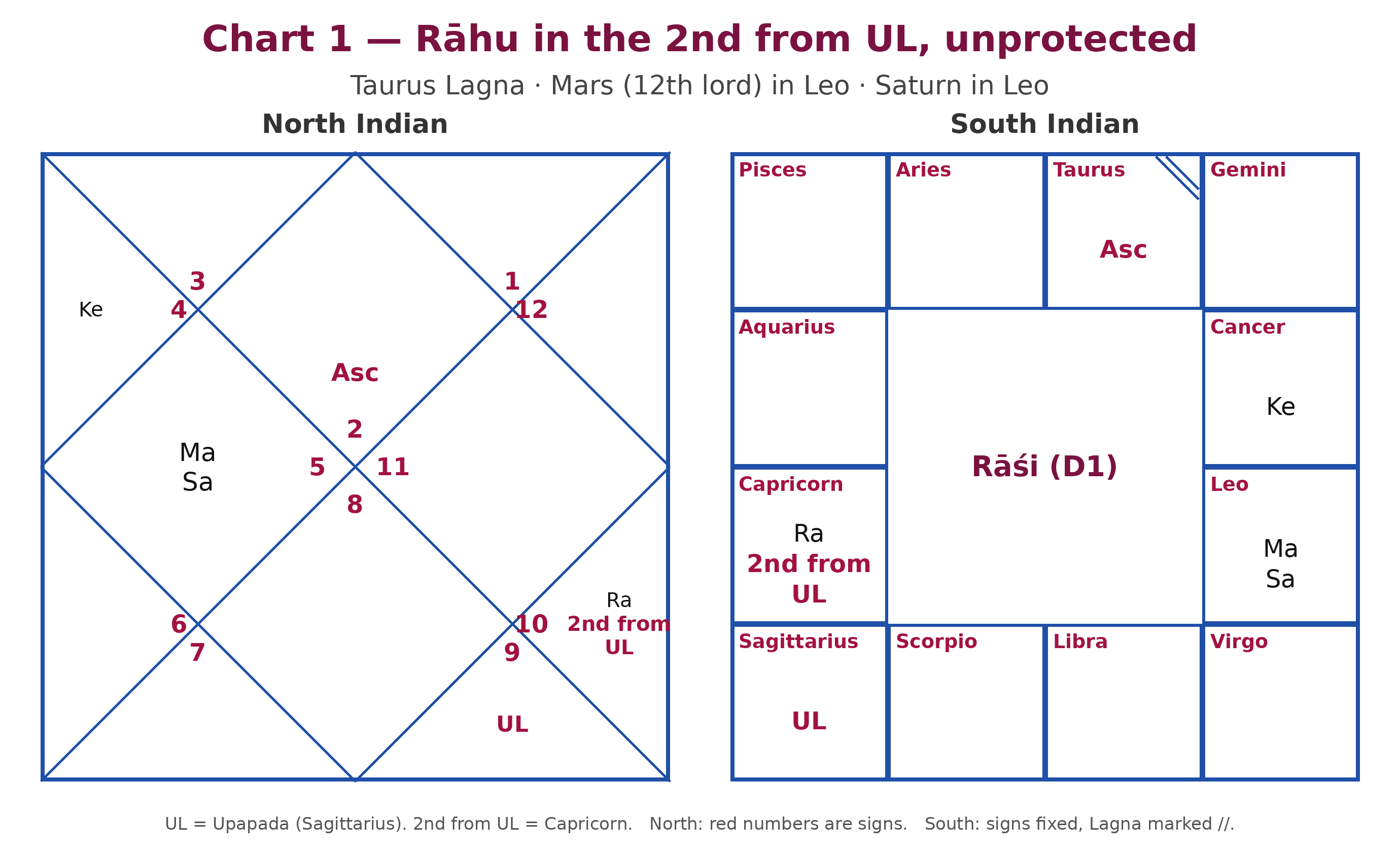
- Rule 2 applies: a malefic joins the 2nd from the Upapada.
- Rule 4 does not rescue it, because no benefic touches the house.
- Rule 6 does not rescue it either, because the lord of the 2nd is in neither its own sign nor exaltation.
- The classical reading is a marriage at risk of loss or separation.
Chart 2. The same Rāhu in Capricorn, but Jupiter in Cancer aspects Capricorn, and Saturn sits in its own sign, Aquarius.
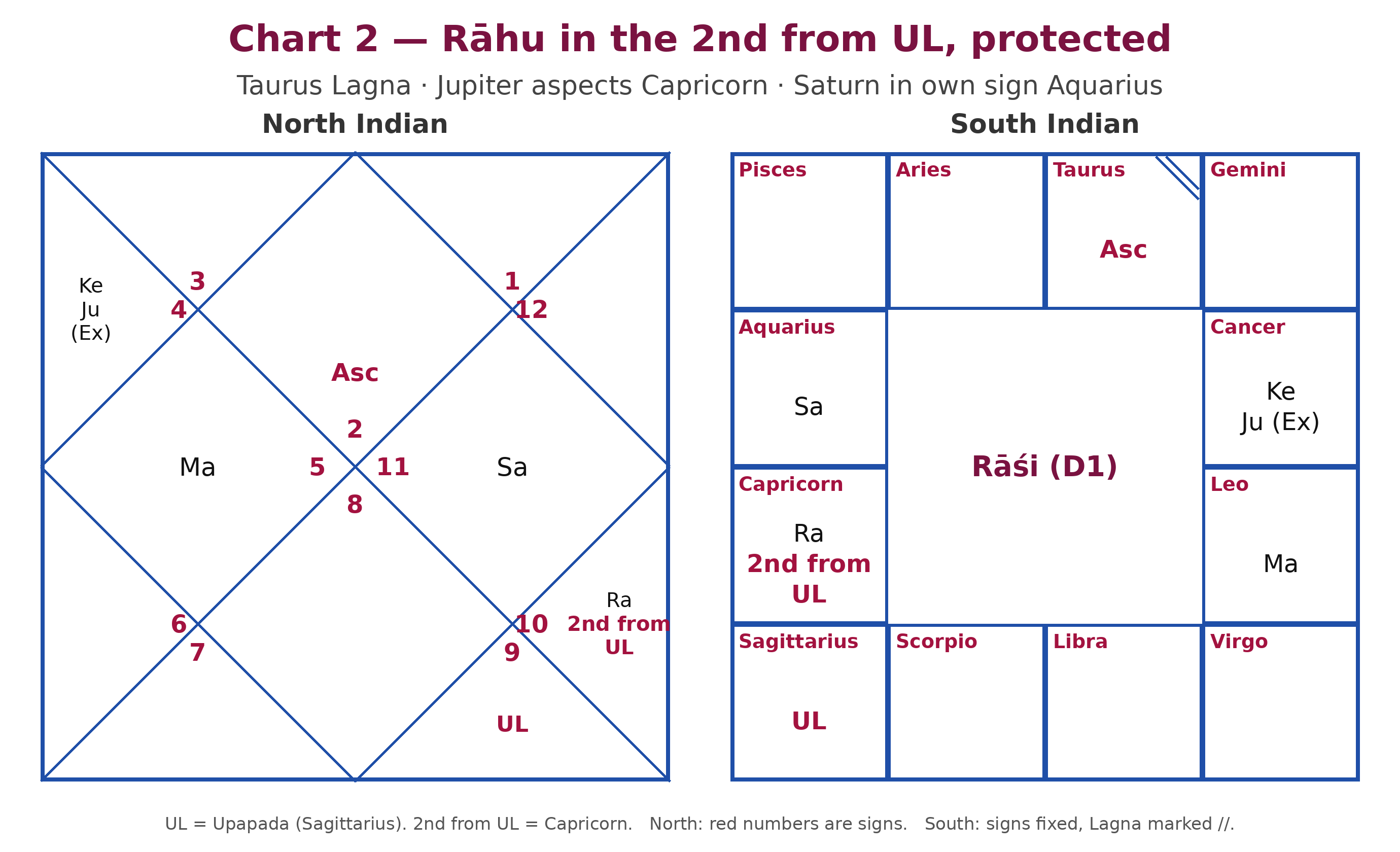
- Rule 2 still names the danger.
- Rule 4 now applies: a benefic aspects the house, and Jaimini 1.4.4 says the loss "does not happen".
- Rule 6 applies too: the lord of the 2nd is in its own sign, so the spouse is kept until late in life.
- The classical reading is a marriage under strain that holds.
The lesson of the chapter is in that contrast. The texts never judge a malefic in the 2nd from the Upapada alone. They always weigh it against benefic influence and against the strength of the 2nd lord.
Summary of the classical rules
| Condition | Result | Source |
|---|---|---|
| Upapada with benefics, in a benefic sign | Full happiness from spouse and children | BPHS 30.3–4 |
| Upapada with malefics, in a malefic sign, malefic aspect | Renunciation or no spouse, unless benefics intervene | BPHS 30.4–5 |
| Malefic joining or aspecting the 2nd from UL | Loss of spouse or renunciation | Jaimini 1.4.2; BPHS 30.7–8 |
| Sun in the 2nd from UL | Not malefic, unless debilitated or in an enemy's sign | Jaimini 1.4.3; BPHS 30.6 |
| Benefic joining or aspecting the 2nd | The loss does not occur | Jaimini 1.4.4; BPHS 30.7 |
| Planet in the 2nd debilitated in rāśi or navāṁśa, joined by a cruel planet | Loss of spouse | Jaimini 1.4.5; BPHS 30.8 |
| Exalted planet in, or exalted aspect on, the 2nd | More than one spouse | Jaimini 1.4.6; BPHS 30.9 |
| UL or its 2nd in Gemini | More than one spouse | Jaimini 1.4.7; BPHS 30.10 |
| Lord of the 2nd in the 2nd, or in its own sign (or Venus in own sign) | Spouse kept until late in life | Jaimini 1.4.8; BPHS 30.11–13 |
| UL lord exalted / debilitated | Spouse from a good / humble family | Jaimini 1.4.9–10; BPHS 30.14 |
| Benefics with the UL or its 2nd | Beautiful, virtuous spouse | Jaimini 1.4.11; BPHS 30.15 |
| Saturn and Rāhu in the 2nd from UL | Separation or loss through slander | Jaimini 1.4.12; BPHS 30.16 |
The Upapada does not stand alone. A full judgment of marriage also reads the 7th house and its lord, Venus, the Dārakāraka, the Navāṁśa and the daśās. But for the question the guṇa table never asks, whether a marriage will last, the Upapada is where the classical texts look first.
Sources
- Bṛhat Parāśara Horā Śāstra, chapter 29 (Ārūḍha pada, verses 2–5) and chapter 30, Upapadādhyāya. Verse numbers follow the R. Santhanam edition (Ranjan Publications); in Girish Chand Sharma's edition (Sagar Publications) the Upapada chapter is chapter 32.
- Jaimini Upadeśa Sūtras, Adhyāya 1, Pāda 4, sūtras 1–22, with the translations of Sanjay Rath (Jaimini Maharishi's Upadesa Sutras, Sagar Publications) and P. S. Sastri (Jaimini Sutras, Ranjan Publications). Sūtra numbers follow the Jaimini Upadeśa Sūtras themselves, as adhyāya.pāda.sūtra: 1.4.2 is Adhyāya 1, Pāda 4, Sūtra 2.
- The English translations in this article are the author's own.
Thoughts? Leave a Comment