What Is Vedic Jyotiṣa, and How Is It Different from Western Astrology?
A worked example: why the Sun in your Vedic chart may sit one sign earlier than in your Western horoscope
If you've ever compared your Western sun sign to your Vedic (Jyotiṣa) rāśi and found they don't match — and for most people born after the early 1900s, they genuinely don't — the reason isn't error or inconsistency between systems. It's because Western and Vedic astrology are, quite literally, measuring the sky against two different backdrops. Understanding why is the single most useful thing to grasp before going any further into Jyotiṣa, because it explains almost every structural difference that follows.
Two Zodiacs, One Sky
Both systems divide the sky into the same twelve 30° segments — Aries through Pisces — and both call these segments by the same names. Where they part ways is in deciding where the circle actually begins.
The Western (Tropical) Zodiac
Western astrology anchors 0° Aries to the spring equinox — the precise moment the Sun crosses the celestial equator each year, currently around 20-21 March. This point is fixed relative to the seasons, not to the actual stars. It's called the tropical zodiac precisely because it's tied to Earth's relationship with the Sun, not to the fixed constellations behind it.
The Vedic (Sidereal) Zodiac
Vedic Jyotiṣa anchors 0° Aries to a fixed point among the actual background stars — traditionally, the beginning of the constellation Aśvinī. This is called the sidereal zodiac, from the Latin sidus, "star," because it's referenced against the real, physically observable constellations rather than the seasons.
Why They've Drifted Apart
Two thousand years ago, these two starting points were nearly identical. They no longer are, because of a slow wobble in Earth's own rotational axis called the precession of the equinoxes — the same wobble a spinning top exhibits as it slows down. This wobble completes one full cycle roughly every 25,800 years, and its effect is that the equinox point drifts backward through the fixed constellations by about 1° every 72 years.
Over two millennia, that drift has accumulated to roughly 24°. This accumulated gap — the angular distance between the tropical zero-point and the sidereal zero-point at any given moment — is called the ayanāṃśa. The most widely used calculation in Vedic astrology, the Lahiri ayanāṃśa (also called the Chitrapakṣa ayanāṃśa), currently places this gap at approximately 24°10′.
What This Means for Every Planet in Your Chart
To convert a planet's tropical (Western) position into its sidereal (Vedic) position, Jyotiṣa simply subtracts the ayanāṃśa — roughly 24° — from the tropical longitude.
Vedic (sidereal) longitude = Western (tropical) longitude − ayanāṃśa
Since each sign spans exactly 30°, and the ayanāṃśa is currently about 24°, this subtraction is almost — but not quite — enough to push a planet back a full sign. In practice, this means: if a planet sits in the first 6° of a sign in the Western tropical chart, it will fall into the previous sign entirely once the ayanāṃśa is applied. A planet placed deeper within a sign (past roughly 6°) will usually stay in the same sign, just shifted 24° earlier within it.
This is the entire reason Vedic "sun signs" so often surprise people raised on Western astrology — it isn't a different calculation of the same thing, it's a genuinely different reference frame.
A Worked Example
Consider an illustrative birth chart where the Sun's Western (tropical) position works out to 15° Taurus. Applying the current Lahiri ayanāṃśa of approximately 24°10′:
15° Taurus (tropical) − 24°10′ (ayanāṃśa) = 20°50′ Aries (sidereal)
The Sun doesn't just shift a few degrees within Taurus — it crosses the sign boundary entirely and lands in Aries, the sign immediately before it. This is exactly the pattern behind your question: in the Vedic chart, the Sun appears in the house/sign before the one Western astrology shows, precisely because the sidereal zodiac's zero-point sits about 24° behind the tropical zodiac's.
Diagram 1 — Sun's Position, Western (Tropical) Reckoning
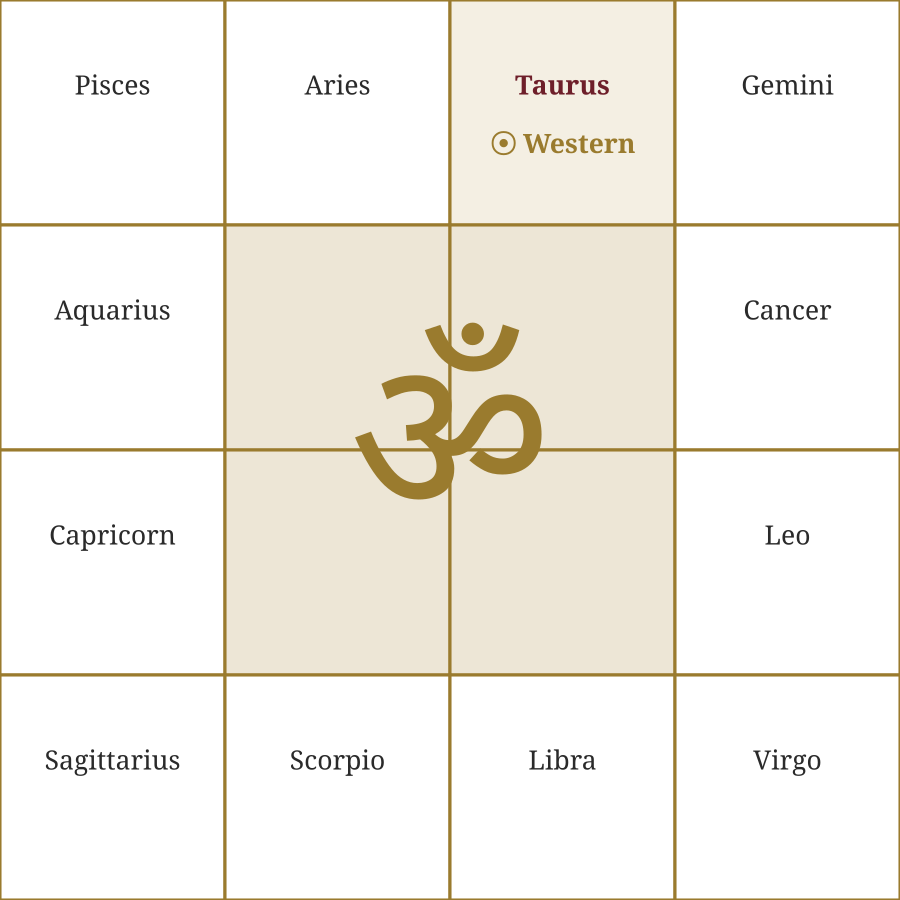
The Sun (15°) falls in Taurus when measured against the tropical/seasonal zodiac.
Diagram 2 — Same Sun, Vedic (Sidereal) Reckoning
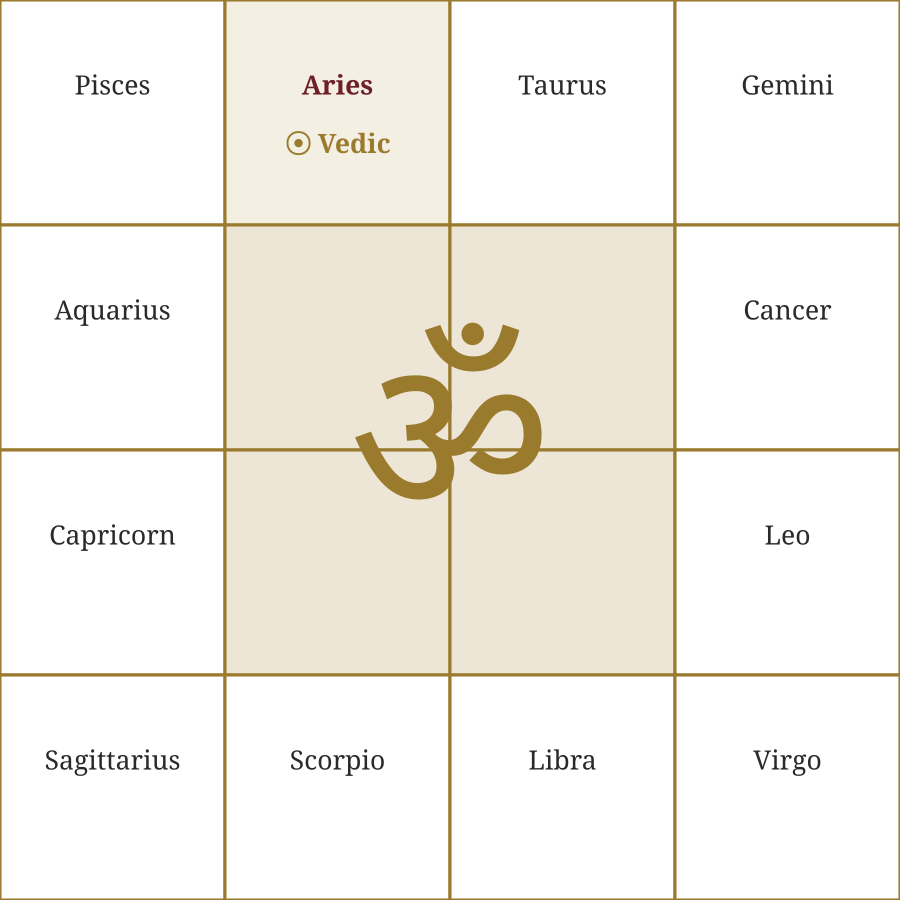
The identical physical position of the Sun, re-expressed against the sidereal zodiac, falls in Aries — one sign earlier — once the ~24° ayanāṃśa is subtracted.
Both diagrams describe the exact same moment in time and the exact same Sun sitting in the exact same place in the physical sky. Nothing about the Sun has moved. What has changed is only the ruler we're measuring it against — and that difference is enough to move it into an entirely different sign, with all the interpretive consequences that follow from a different sign lord, different nakṣatra, and — since these South Indian diagrams use whole-sign houses — a different house as well.
Beyond the Zodiac: Three More Structural Differences
1. The Chart Diagram Itself
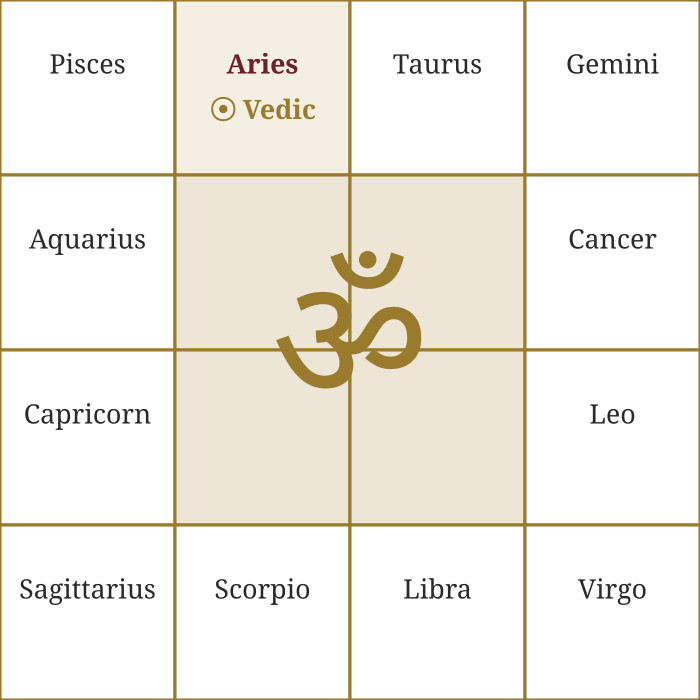
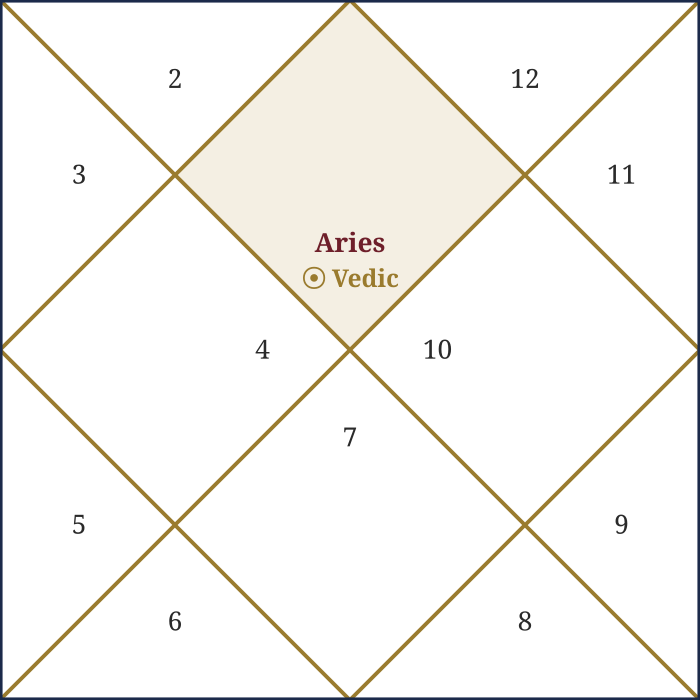
The South Indian style shown above — also called the Guru Cakra — uses a fixed square grid. The twelve signs always sit in the same twelve boxes, in the same order, no matter whose chart you're looking at. Only the label marking the Ascendant (Lagna) moves from chart to chart. This is different from the North Indian style, also called the Śukra Cakra, which is diamond-shaped — there, the Ascendant is always fixed at the top, and it's the signs that rotate around it instead. Both differ from the Western circular wheel, where house cusps are drawn at the exact degree the Ascendant and subsequent houses fall, rather than snapping to whole sign boundaries.
The same Vedic (sidereal) Sun-in-Aries placement from Diagram 2 above, drawn in both regional conventions:
 |  |
| South Indian (Guru Cakra) | North Indian (Śukra Cakra) |
The same underlying placement — Sun in Aries — drawn two different ways. The South Indian (Guru Cakra) chart keeps the signs fixed and moves the house numbers; the North Indian (Śukra Cakra) chart keeps the houses fixed — Lagna always at the top — and moves the sign numbers instead.
2. Whole-Sign Houses and the Use of Cusps
Classical Vedic astrology's default and most widely taught house system is whole-sign — the sign containing the Ascendant is treated as the entire 1st house, the next sign the entire 2nd house, and so on, regardless of what degree the Ascendant actually falls at within that first sign. This is the system reflected in the diagrams above, and it remains the standard starting point across most of the tradition.
It would be inaccurate, though, to say Vedic astrology has no use for cusps. Several classical and widely-practiced sub-systems bring degree-based cusp calculation in for specific, well-defined purposes: the Bhāva Cakra (Chalit chart) recalculates house cusps from the Ascendant's exact degree rather than the whole sign, and is regularly consulted alongside the Rāśi chart to check whether a planet sitting near a sign boundary should be read as functioning in the adjacent house. The Śrīpati house system, used by some traditional schools, is a cusp-based method broadly comparable in spirit to Western quadrant systems. Praśna (horary) astrology likewise leans on the exact rising degree far more precisely than a whole-sign Rāśi reading requires. Western astrology, for its part, most commonly uses quadrant systems like Placidus or Koch, which divide the chart based on the exact time and place of birth and can produce houses of noticeably unequal size — but even there, whole-sign houses have a documented ancient pedigree and have seen a real revival in parts of the modern Hellenistic astrology community. The more accurate statement, in both directions, is one of differing default emphasis rather than an absolute either/or: Vedic practice leads with whole-sign and reaches for cusps in specific technical contexts, while Western practice today leans the other way.
3. Nakṣatras and the Daśā Timeline
Vedic Jyotiṣa divides the zodiac not only into 12 signs but into 27 nakṣatras (lunar constellations) of 13°20′ each, with no equivalent structure in Western practice. These nakṣatras feed directly into the Vimśottarī daśā system — a sequence of planetary periods, unique to each birth chart, that Jyotiṣa uses to time when specific life events are likely to unfold. Western astrology has no direct counterpart to this; its predictive tools (transits, progressions, solar returns) work quite differently, tracking the current sky's relationship to the birth chart rather than unfolding a pre-mapped internal timeline.
Glossary — The Navagraha
Every Vedic chart — South Indian, North Indian, or any other regional style — is built from the same nine graha ("seizers" or planetary influences): seven physical bodies plus the two lunar nodes, Rāhu and Ketu, which are mathematical points rather than physical bodies but are treated as full grahas in Jyotiṣa. The table below gives each graha's Sanskrit name, its standard astrological glyph, and the two-letter abbreviation used on chart diagrams.
| Graha (Sanskrit) | English | Symbol | Abbrev. | Nature |
| Sūrya | Sun | ☉ | Su | Kṛūra (mild malefic); soul, authority, father |
| Candra | Moon | ☽ | Mo | Saumya (benefic) when waxing; mind, mother |
| Maṅgala / Kuja | Mars | ♂ | Ma | Kṛūra (malefic); courage, energy, siblings |
| Budha | Mercury | ☿ | Me | Neutral — benefic/malefic by association; intellect, speech |
| Bṛhaspati / Guru | Jupiter | ♃ | Ju | Saumya (benefic); wisdom, dharma, expansion |
| Śukra | Venus | ♀ | Ve | Saumya (benefic); love, beauty, relationships |
| Śani | Saturn | ♄ | Sa | Kṛūra (malefic); discipline, delay, longevity |
| Rāhu | North Lunar Node | ☊ | Ra | Chāyā graha (shadow planet); desire, illusion, foreign |
| Ketu | South Lunar Node | ☋ | Ke | Chāyā graha (shadow planet); detachment, mokṣa |
Rāhu and Ketu are always placed exactly 180° apart in any chart, since both mark the two points where the Moon's orbital path crosses the ecliptic (the lunar nodes) — a purely geometric relationship rather than a physical one, which is why they are classed separately as chāyā graha, "shadow planets," distinct from the seven physically observable bodies.
Why This Matters
None of this makes one system "more correct" than the other in an absolute sense — they're answering different questions, using different reference frames, built up over different (though related) intellectual traditions. But if you've ever wondered why your Vedic rāśi doesn't match your Western sun sign, now you know precisely why, down to the degree: a slow 25,800-year wobble in the Earth's axis, accumulated over two thousand years into a roughly 24° gap between two equally valid ways of asking "where is the Sun, really?"
In the next article, we'll look at how this same ayanāṃśa shift plays out across an entire chart, not just one planet — and why the Ascendant itself is often the placement most dramatically affected by the switch from tropical to sidereal reckoning.
Thoughts? Leave a Comment